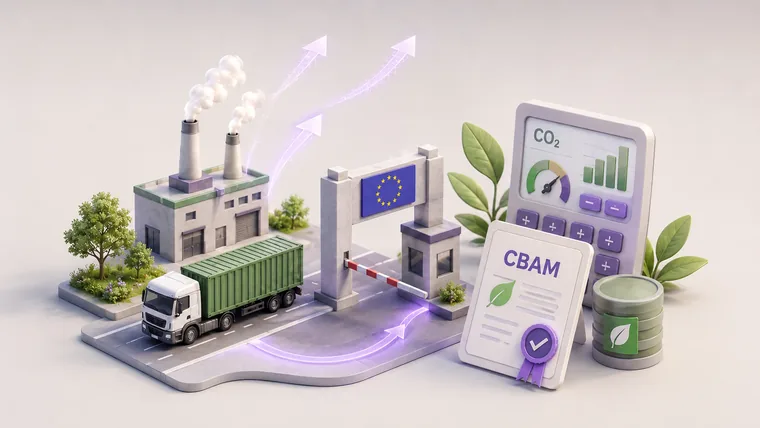
CBAM gets costly when supplier data is missing and future exposure is unclear.
Yodiwo helps you understand your covered imports, calculate embedded emissions, see the impact of actual vs. default data and forecast future CBAM costs — with every calculation clear and traceable.
CBAM Management
How It Works
Four steps to understand, calculate and plan your CBAM exposure.
01
Bring your imports and suppliers together
See your covered imports, products, countries and suppliers in one place — so you know where your CBAM exposure comes from.
02
Use actual or default emissions data
Use supplier-specific emissions data when available. When it’s missing, apply the relevant default values and see the impact on your CBAM cost.
03
Calculate embedded emissions
Calculate the embedded emissions behind each imported good using the applicable data, factors and methodology. Open any calculation to see exactly how the result was reached.
04
Understand your CBAM cost
Translate your emissions into estimated CBAM cost and see what is driving the number — from supplier data to certificate-price assumptions.
Forecasting
Don’t just calculate CBAM. Forecast it.
CBAM cost changes as certificate prices, import volumes and supplier data change. With Yodiwo, you can model different scenarios and see what they could mean for your future exposure.
Change your assumptions
Test different import volumes and certificate prices.
Compare supplier scenarios
Add a potential supplier and see how different emissions data could change your future cost.
See what’s coming
Forecast your CBAM exposure over the coming years instead of finding out after the cost has already landed.
Projected CBAM costIllustrative
Default valuesCurrent assumptionsActual supplier data
Your outcome
Walk away knowing what is driving your CBAM cost today and what could change it tomorrow.
See where supplier data is missing, understand every calculation and give finance, procurement and sustainability teams a clearer view of future CBAM exposure.
Pricing
Tailored to your imports
Pricing depends on the goods and import volumes you manage through CBAM Management. Book a demo and we will look at your CBAM needs and the setup that fits your business.
No credit card required
Stop guessing at your CBAM cost.
See your exposure today, forecast what comes next and test your options before CBAM becomes a budget surprise.
FAQ
CBAM Management
What importers ask most about the Carbon Border Adjustment Mechanism.
01
What is CBAM, in plain terms?
CBAM is the EU’s way of putting a carbon cost on certain goods imported from outside the EU. If your company imports covered products, you need to understand the emissions created during production and account for the corresponding CBAM cost.
02
Which goods does CBAM cover?
CBAM currently covers iron and steel, aluminium, cement, fertilisers, hydrogen and electricity, along with certain related products. The European Commission has also proposed expanding CBAM to additional downstream products in the future.
03
Does CBAM apply to me?
It depends on what you import and how much. A 50-tonne annual threshold applies to covered cement, iron and steel, aluminium and fertiliser imports. Hydrogen and electricity follow different rules. The first step is understanding which of your imports fall within scope.
04
What do I actually have to do?
The definitive CBAM regime started on 1 January 2026. Importers in scope need to identify covered goods, collect the relevant emissions information, calculate their CBAM exposure and meet the applicable declaration and certificate obligations. The first annual declaration covering 2026 imports is due in 2027.
05
How is my CBAM cost calculated?
Your CBAM exposure depends on the embedded emissions of the goods you import and the applicable certificate price. It can also change as your import volumes, supplier emissions and carbon prices change. CBAM Management brings those variables together so you can understand both today’s cost and what could happen next.
06
What if my supplier cannot give me emissions data?
You can still calculate your exposure using the applicable default values where permitted. CBAM Management clearly shows where supplier-specific data is being used and where a default value has been applied — so you can see the impact missing supplier data has on your cost. When better data becomes available, you can update it and compare the result.
07
What does CBAM Management actually do for me?
It goes beyond a basic CBAM calculator. You can see which imports are driving your exposure, work with actual or default emissions data, understand how each calculation was made and forecast how your costs could change over time. You can even model a potential new supplier to see what a sourcing decision could mean for future CBAM cost.
08
Can I see how each calculation was made?
Yes. You can open the calculation behind a result and see the factors, source data and methodology used. That means your team can understand where every number came from instead of relying on a black-box calculation.
09
Can I forecast future CBAM costs?
Yes. You can model different import volumes and certificate-price assumptions to see how your CBAM exposure could develop over time. You can also add a prospective supplier and compare how their emissions data could affect future costs before making a sourcing decision.
10
Do I need to be a CBAM expert to use it?
No. CBAM Management brings your imports, supplier data, calculations, regulatory reference information and forecasts into one place. You can follow the numbers without having to work through spreadsheets, separate calculation files and thousands of pages of regulation every time.
11
What happens if I don’t comply with CBAM?
Failing to meet CBAM obligations can lead to financial penalties, while outstanding certificate obligations may still remain. Keeping your import, emissions and calculation data organised throughout the year makes compliance much easier than trying to rebuild the picture at the deadline.
12
How quickly can I get started?
You can begin by mapping your covered imports and suppliers and adding the emissions information you already have. From there, you can see where data is missing, calculate your current exposure and start forecasting future CBAM costs.