July 2026 —comparison of the tools companies use to run a Double Materiality Assessment Software: what each platform can actually do, how you can access it, and what it costs.
A double materiality assessment (DMA) is the first step of sustainability reporting under the EU rules: it decides which of the ten ESRS topics — from climate change to your own workforce — your company actually has to report on. Done by hand it typically takes months. A new generation of software compresses it to days — but the platforms differ enormously in what they can actually do: how deep the workflow goes, whether stakeholders are engaged, whether the result would stand up to an auditor, what the AI does, and where the output ends up.
Why run a double materiality assessment
A DMA looks at every sustainability topic from two sides: your company’s impact on people and the environment (impact materiality), and the financial risks and opportunities those topics create for your business (financial materiality). A topic that crosses either threshold is material — and must be reported. Three forces make this the starting point of ESG work now:
- The EU’s CSRD makes the DMA mandatory for in-scope companies, and the 2026 “Simplified ESRS” changes kept it as the filter that decides what you disclose. Smaller companies reporting voluntarily under the VSME standard run a lighter version of the same exercise.
- Banks and customers. Lenders and large buyers increasingly ask even out-of-scope companies which sustainability topics are material to them — a DMA is the credible answer.
- Beyond compliance, the DMA is simply how you find out where your real sustainability risks and opportunities sit, before spending money on the wrong ones.
DMA platforms at a glance – full capabilities
| Tool | Start today? | Guided workflow | Stakeholders involved? | Auditor-ready? | AI | Result feeds your report? | Price |
| Yodiwo | Yes — instant demo | ✓ 6 guided steps | ✓ surveys | ✓ sign-off + audit view | ✓ SOPHIA assistant | ✓ ESRS, VSME, GRI | Not yet public |
| Generation Impact Global | Almost — ~24h wait | ✓ 5 guided steps | ✓ voting | ✓ auditor sign-off | — | — you re-key it | €0 forever |
| Canonical ESG | Yes — no account | ✓ 7 guided steps | ✓ auto surveys | ○ method note only | — | — you re-key it | Free |
| Upright | Yes — free tier | AI computes it | — AI replaces them | ○ audit log | ✓ the engine itself | — you re-key it | Free tier · €5k–20k/yr |
| Emistra | Yes — no account | Preset questions (suite = full) | — | ○ in the suite | ○ auto-scoring | ○ its own suite | €199–1,999/mo |
| Materiality Master | No — buy or demo | ✓ 4 guided steps | ✓ | ✓ audit trail | ○ assistant | — you re-key it | €449/mo · €2,499/yr |
| Socialsuite | No — demo only | ✓ | ✓ its own surveys | ○ top tier | ○ | ○ its own suite | Not public |
| Position Green | No — demo / tour | ✓ module in suite | ○ | ○ | ✓ AI Analyst | ○ its own suite | Not public |
Legend: ✓ = yes / strong · ○ = partial, or on a specific tier (marked) · — = no / not the model. The table describes each platform as a whole; where a capability sits only in a paid tier, the cell says so. Prices are the vendors’ own published figures; “not public” means demo- and quote-led.
Quick picks
- Genuinely self-serve, start today: Yodiwo (register into an instant pre-loaded demo), Canonical ESG and Emistra (no account at all), and Upright (instant free tier) are the tools you can touch without a demo, sales call, or upfront payment.
- Full audit-grade workflow that feeds your reports: Yodiwo — the only tool here that combines instant entry with a materiality-to-report loop: the finished DMA flows into EnGage, which produces the ESRS, VSME and GRI reports.
- AI computes the assessment: Upright — a science engine produces the DMA across 80+ ESRS matters with no surveys; the financial half sits in the paid tiers.
- Software-plus-advisory platforms: Socialsuite and Position Green — the strongest engagement and advisory depth, sold demo-led.
The best Double Materiality Assessment Software in 2026
DMA-first tools you can start yourself
1. Yodiwo Double Materiality Assessment
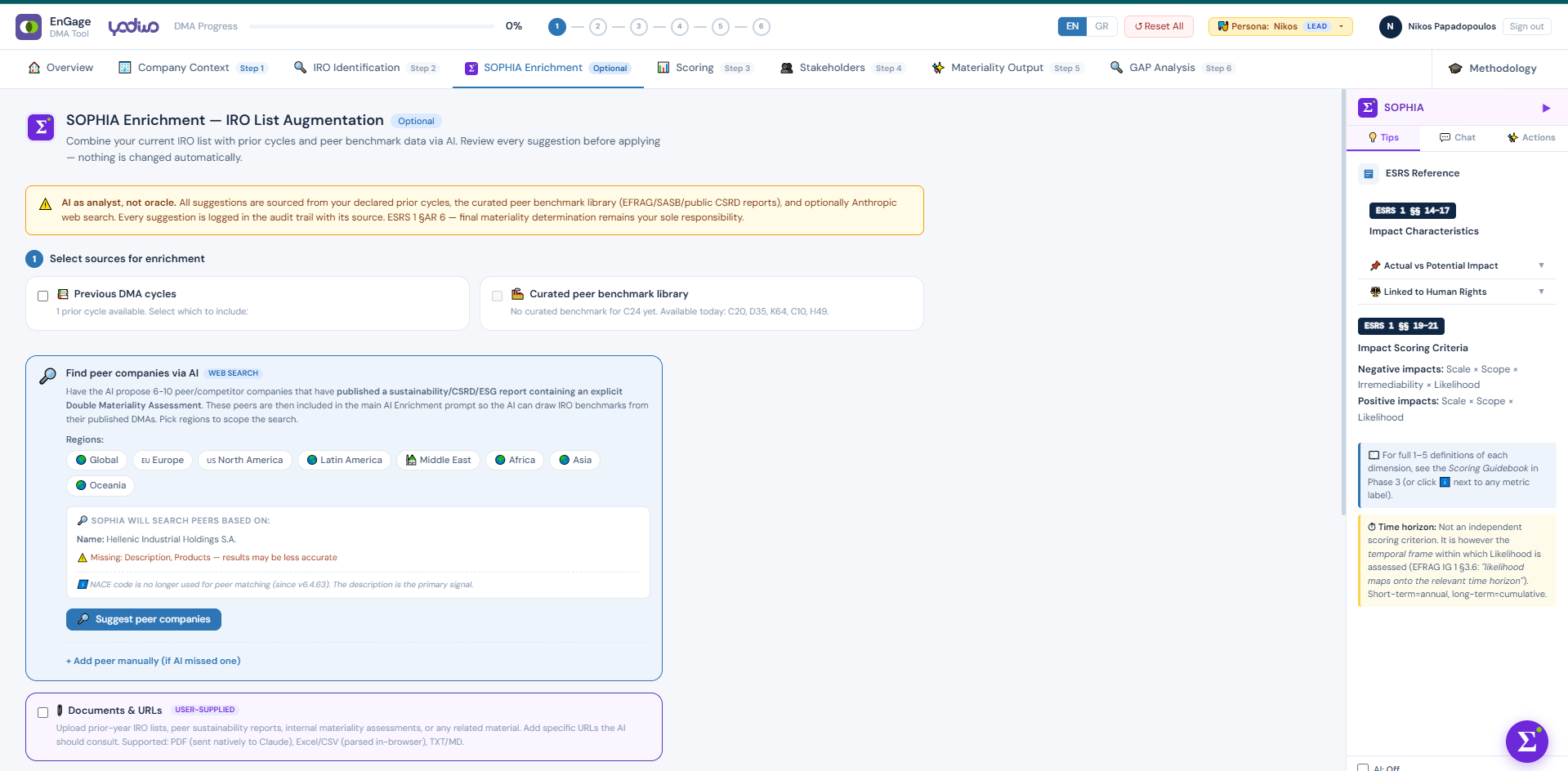
What it is — Yodiwo is a European sustainability-tech company with a suite of ESG tools — a self-serve Sustainability Marketplace for smaller companies and the EnGage platform for larger ones. Its Double Materiality Assessment tool covers the whole DMA — identifying your impacts, risks and opportunities (IROs), scoring them on both materiality lenses, validating with stakeholders, and producing the materiality matrix, ESRS scope and a CSRD gap analysis — in days rather than the months a manual or consultant-led assessment usually takes.
Key features
- A six-step guided workflow: company context → IRO identification → impact & financial scoring → stakeholder validation → materiality matrix & ESRS scope → CSRD gap analysis
- A sector-specific IRO database pre-filters the impacts, risks and opportunities relevant to your industry across all ten ESRS topics — no blank page
- A built-in stakeholder engagement workflow — invitations, surveys and stakeholder output feeding straight into validation
- Audit-grade governance: assessments run in cycles with versions, a formal sign-off and a dedicated audit view
Free tier & access — Register and you land in a pre-loaded demo company with a finished, signed-off assessment you can click through immediately — no sales call, no credit card. The demo is for exploring; your own assessment is arranged with Yodiwo.
What sets it apart — The features that carry the workflow. SOPHIA, the AI assistant, expands your IRO list from your company context, analyses the evidence you attach and generates a GAP Summary & Action Plan — a to-do list, not just a matrix. A sector-specific IRO database removes the blank page, and cycles, versions and formal sign-off make the result one an auditor can follow. Finally, the finished DMA flows into EnGage, which generates the ESRS, VSME and GRI reports — so assessment and disclosure share one evidence trail.
Pricing — Not yet public; arranged directly with Yodiwo.
For a company, consider — Pricing is not yet published, so budgeting starts with a conversation with Yodiwo. And if testing the AI enrichment yourself is part of your evaluation, note that SOPHIA runs in the production version — the public demo shows the guided workflow with SOPHIA switched off.
Best for — Companies that want a guided, audit-ready Double Materiality Assessment Software they can start exploring today — especially those that will also produce their ESRS, VSME or GRI report and want the assessment to feed it directly.
Explore Yodiwo’s DIY Sustainability Marketplace and start for free here.
2. Generation Impact Global

What it is — A Geneva-based (with a Milan office) DMA platform built directly on the EU standards — the full ESRS topic list, updated for the 2026 Simplified ESRS — and aimed at SMEs, enterprises and consultants across the EU and Switzerland, distributed directly and through the OpenES and Azimut marketplaces. The whole platform is free, forever: no user limits, no trial expiry, no locked features; only optional expert support is paid.
Key features
- A five-step guided workflow from scoping to a verified report, following the official ESRS process
- Every impact, risk and opportunity scored for own operations, suppliers and customers — each across short, medium and long term, with the ESRS severity maths built in
- An evidence library on every item, plus a dedicated auditor login that can review, comment and formally sign off, with a full change log
- One-click report in the exact format auditors expect under ESRS (the IRO-1/IRO-2 disclosures), and full data export (JSON, CSV, PDF) with no lock-in
Free tier & access — The free tier is the full product. Entry is not instant: “Start full assessment” submits a request and credentials arrive by email within about 24 hours.
What sets it apart — The scoring depth and the assurance features: every IRO scored across the value chain and three time horizons with the ESRS severity formula built in, a per-item evidence library, and a dedicated auditor role that can review and formally sign off — capabilities other tools charge enterprise prices for, at €0.
Pricing — Free forever; paid implementation support is optional, priced per engagement.
For a company, consider — If you need a result this afternoon, the ~24-hour credential wait matters — and you start from an empty workspace, with no sample assessment to learn from. There is no AI to draft or enrich IROs, so the analysis effort is entirely yours, and the finished DMA must be re-keyed into whatever produces your ESRS or VSME report.
Best for — Companies (and consultants) that want the deepest free Double Materiality Assessment Software available, value the evidence library and auditor sign-off, and do not mind a day’s wait and a standalone output.
3. Canonical ESG
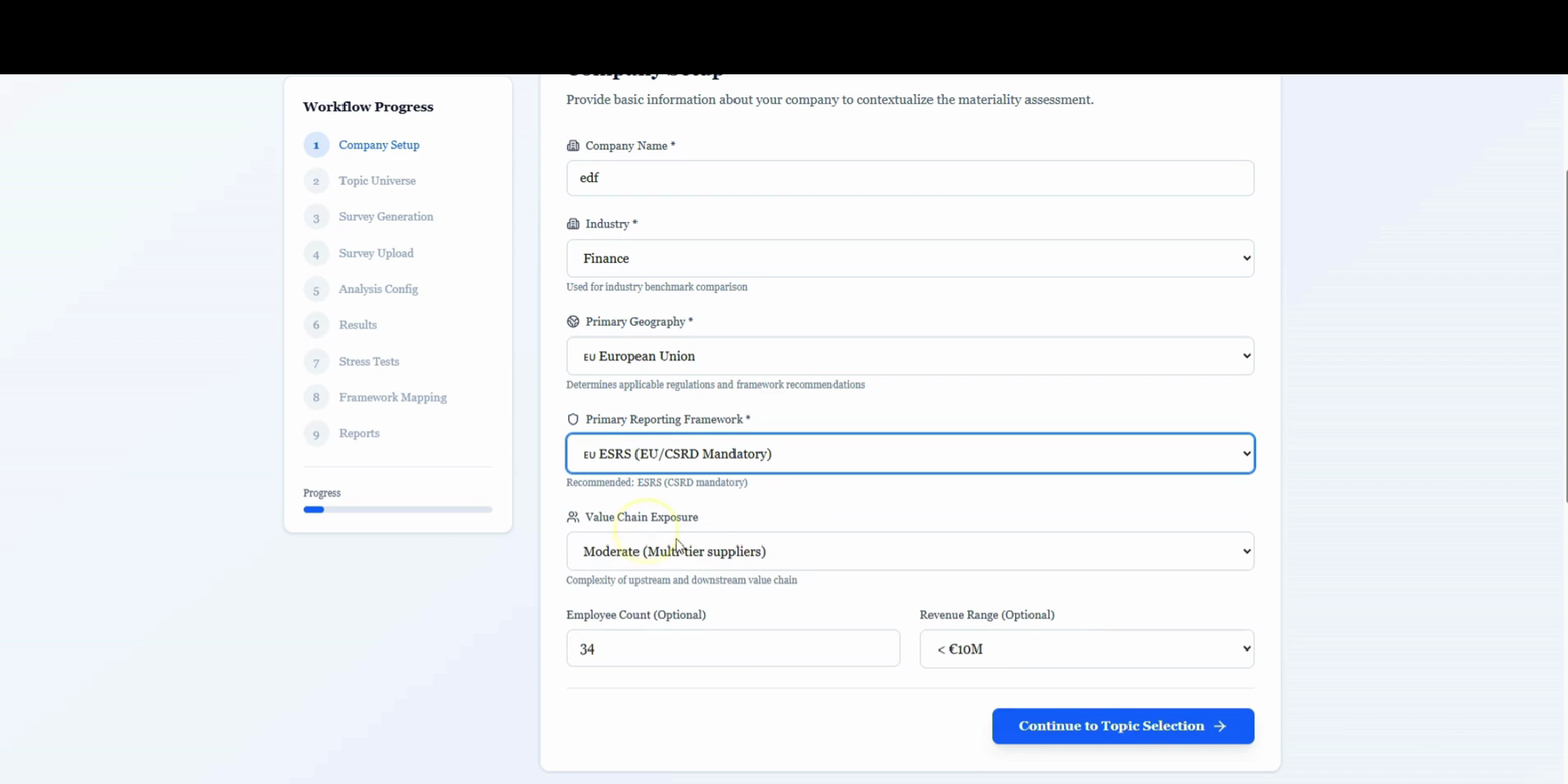
What it is — A framework-agnostic Double Materiality Assessment Software from an independent, self-funded “public infrastructure initiative” (no HQ or country is disclosed) — one of fifteen free tools it operates. It works across seven frameworks — ESRS, GRI, SASB, CDP, ISSB, TCFD and BRSR — rather than being built for the EU rules alone, and the whole tool is free with no account.
Key features
- A seven-step flow from company setup to a board-ready report, with auto-generated stakeholder surveys (share a link or upload responses via templates)
- Configurable stakeholder weights and automatic materiality thresholds, backed by a written methodology statement
- Stress testing — see whether your result would change under scenarios like investor pressure or regulatory tightening
- Output includes the materiality matrix, per-topic justification, an implementation roadmap and an executive summary
Free tier & access — The free Double Materiality Assessment Software is the whole product: open the page and start — no account, no credit card.
What sets it apart — The methodology features: auto-generated stakeholder surveys, configurable weights with automatic thresholds, a written methodology statement, and stress testing of the result.
Pricing — Completely free, no registration.
For a company, consider — If the assessment must survive an auditor, this is not built for that: the platform itself labels the output “directional” and “non-authoritative”, and there is no sign-off, versioning or evidence layer. Everything is manual entry — no AI assistance — and the result does not feed a reporting tool of yours.
Best for — Companies that want a serious, structured first pass — especially those reporting under several frameworks at once — before committing to an assessment they will defend to an auditor.
4. Upright Project
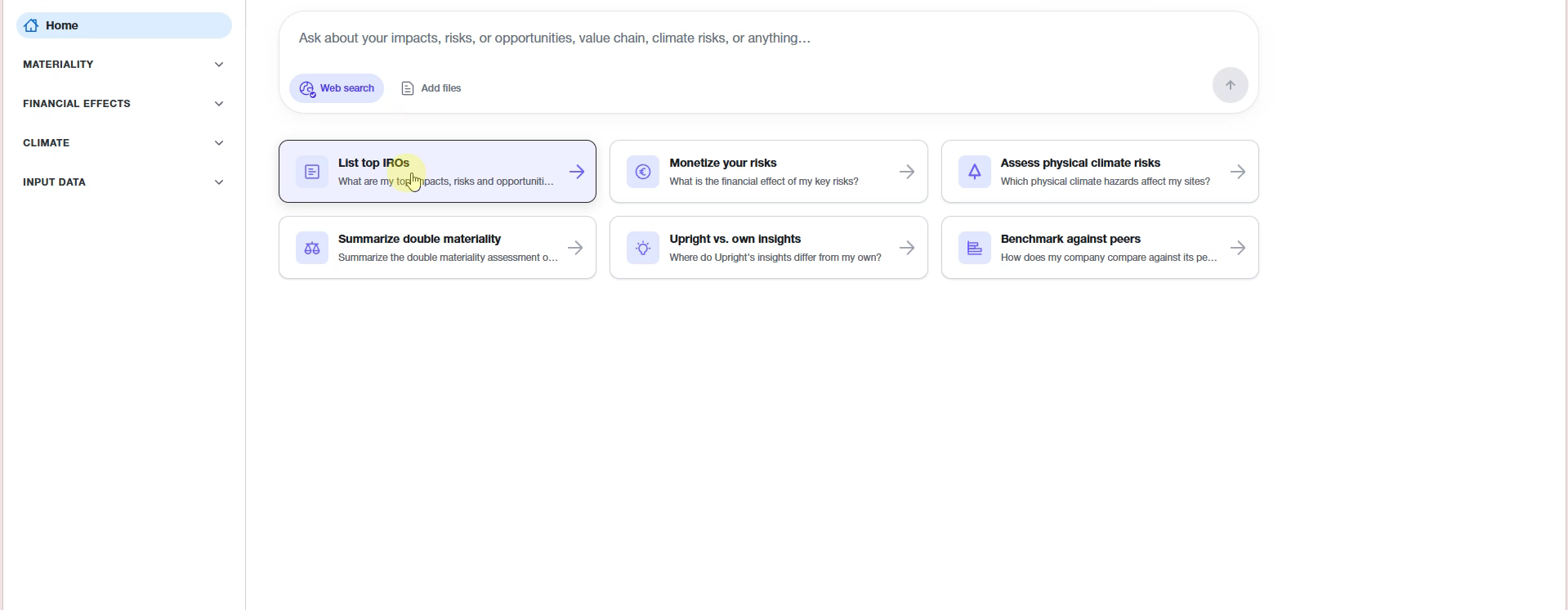
What it is — A Finnish platform (Upright Oy) whose AI/science engine. You submit your products, services, revenue weights, geography and financials; the engine produces a science-based DMA across all 80+ ESRS sustainability matters, which you then refine. There are no surveys or workshops — the model replaces them.
Key features
- A DMA baseline across all 80+ ESRS sustainability matters, refined with company-specific inputs — every assumption and adjustment logged with a clear audit trail
- Output includes the results and visualisations, a methodology document, an assurance guide and a list of ESRS datapoints
- Financial-effects quantification — the impact of material topics on income statement, balance sheet and cash flow — built to plug into enterprise risk management
- An “own insights” layer to overlay your view where you disagree with the model, plus an in-app “Ask AI” assistant
Free tier & access — Sign-up is genuinely instant (“Try for free — no credit card”) into the real platform. The free tier shows the impact side — the materiality matrix, ESRS-structured topics and ranked impacts; the financial-effects data and climate risk sit in the paid tiers.
What sets it apart — The engine and the assurance around it: materiality computed from 300 million+ scientific papers and 70,000 company benchmarks, every adjustment logged in an audit trail, and a methodology document and assurance guide shipped with the results — plus financial-effects quantification that puts numbers on income statement, balance sheet and cash flow.
Pricing — Free tier (impact side); Pro ≈€5,000/year, Enterprise ≈€20,000/year for the financial-effects and climate-risk data.
For a company, consider — There is no stakeholder-engagement workflow, which the EU rules expect in a DMA — you will need to run that step elsewhere. Results are inferred by a model rather than evidenced from your own operations, which some auditors will want supplemented, and completing the financial half of “double” materiality requires the paid tiers.
Best for — Companies that want a fast, evidence-backed assessment without mobilising stakeholders — and can pair it with an engagement step, or pay for the financial half.
5. Emistra
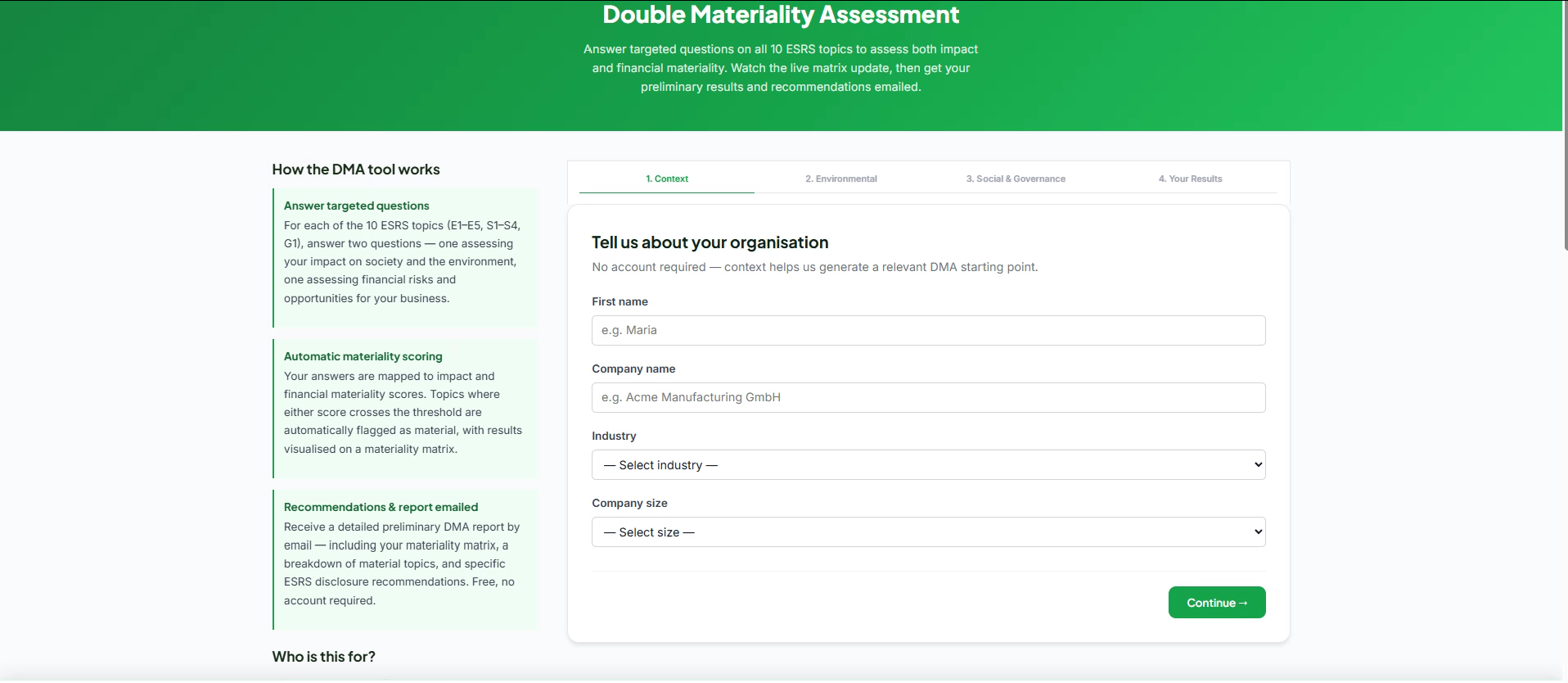
What it is — An ESG reporting platform whose paid suite runs a complete compliance workflow — ERP-connected emissions, a supplier portal, eleven frameworks, an immutable audit trail — fronted by the fastest free DMA taster in this list: roughly 35 multiple-choice questions, no account, and a materiality matrix on screen in 15–20 minutes. The company’s HQ is not stated on its site; its marketing targets EU CSRD reporters, with framework coverage stretching to the US and India.
Key features
- ERP and accounting connections (SAP S/4HANA, Oracle ERP Cloud, Dynamics 365, Xero, QuickBooks) for real-time data sync, or spreadsheet upload
- Automatic emissions calculation across Scopes 1–3 — all 15 Scope 3 categories — with the right emission factor matched per activity and country (DEFRA, EMBER, EPA, USEEIO)
- A supplier portal that collects Scope 3 data from your value chain
- Disclosures across 11 frameworks — ESRS/CSRD, GRI, TCFD, ISSB S1+S2, CDP, EU Taxonomy, SASB, SEC Climate Rule, California SB 253, SEBI BRSR, GHG Protocol
- An immutable audit trail, with audit-ready PDF or structured-data export
- The free DMA: automatic scoring of the ten ESRS topics, a quadrant matrix (material / impact-only / financial-only / low), a per-topic rationale with a disclosure checklist, and an emailed preliminary report
Free tier & access — No account at all for the free Double Materiality Assessment Software— the lowest-friction start anywhere. The platform itself is a subscription.
What sets it apart — The instant analysis: automatic scoring of all ten ESRS topics into a quadrant matrix with a per-topic rationale and a disclosure checklist — and behind it, a suite whose emissions engine connects to your ERP and matches emission factors per activity and country automatically.
Pricing — The preliminary DMA is free; the full platform is a subscription — Essentials €199/month, Growth €799/month, Professional €1,999/month, Enterprise custom.
For a company, consider — You cannot add your own IROs, engage stakeholders or attach evidence in the DMA — it is a preset questionnaire — and how far the suite’s DMA module opens up IRO editing is worth checking in a demo. The results also live in Emistra’s platform rather than feeding a report engine of yours.
Best for — Companies that want a materiality picture this afternoon, and potentially the ERP-connected, multi-framework reporting suite behind it at a known price.
6. Materiality Master
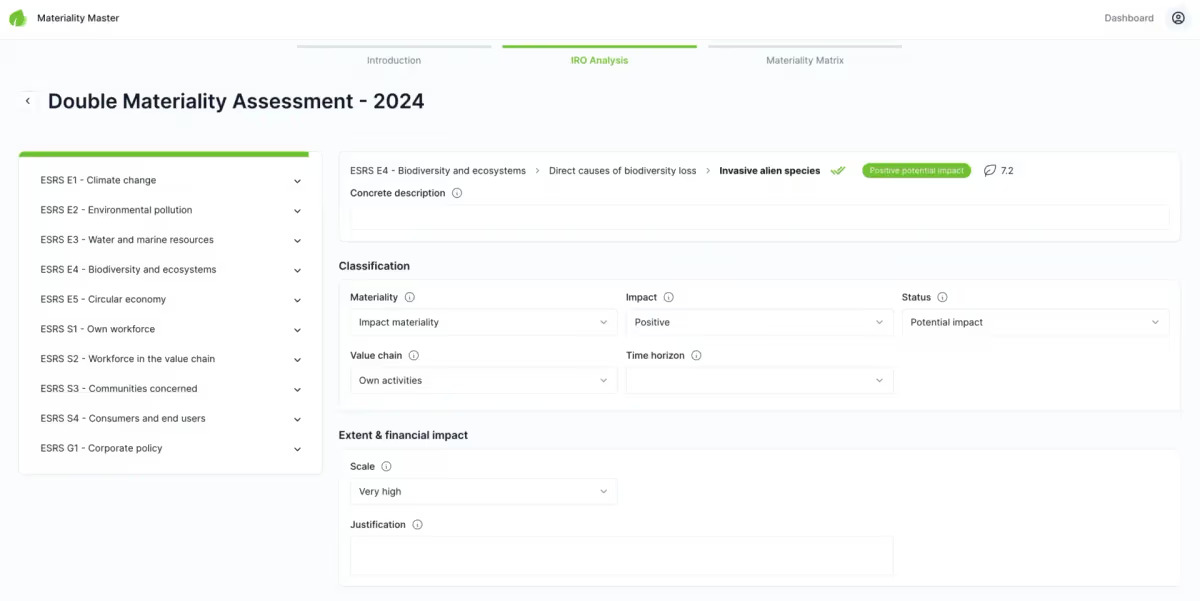
What it is — A focused Double Materiality Assessment Software from the German-speaking market, used by 200+ organisations (STRABAG, DATAGROUP, Tesvolt), with a rare quality in this category: the prices are on the website and you can buy online. Its four-step method — identify stakeholders → identify IROs → assess → map results — ends with its standout feature: automatic mapping of your material topics to 1,100+ specific ESRS datapoints.
Key features
- The deepest ESRS datapoint automation in this list — material topics mapped to the exact datapoints you must report, with Excel/PDF export
- Stakeholder identification, engagement tracking and linkage to impacts
- Auto-generated materiality matrix, audit trail, access management and AI-powered assistance
- Interface in English, German, French and Hungarian; unlimited collaborators
Free tier & access — No free hands-on tier is confirmed — you either buy online or book a demo.
What sets it apart — The datapoint mapper: no other tool here turns material topics into a reportable list of 1,100+ specific ESRS datapoints, exportable to Excel/PDF — and it is one of the few in the category with its full price published and an online checkout.
Pricing — €449/month or €2,499/year with online checkout; a €997 one-time datapoint-mapping product; and a €6,999+ done-for-you “DMA-as-a-Service”.
For a company, consider — There is no free way to try it hands-on before paying — you buy or book a demo — and it is a standalone DMA: the result, datapoint list included, still has to be carried into whatever produces your report.
Best for — Companies (and consultancies) that want to run the assessment themselves at a known price, and value the automatic ESRS datapoint mapping as the bridge from materiality to disclosure.
Software-plus-advisory platforms
A note on fit. The two platforms below are excellent at what they are built for — organisations that want advisors in the room and materiality embedded in a wider platform. That is also the point: advisory engagement and suite adoption take budget and calendar time that a company answering a bank’s or customer’s materiality question this quarter may not have. They are listed because they are credible options — for the right buyer.
7. Socialsuite
What it is — An Australian materiality product (customers include Tabcorp) that pairs software with an advisory team. It builds the assessment from multi-framework topic lists — SASB, GRI and CSRD — with automatic UN SDG alignment, and its proprietary stakeholder-survey technology is the heart of the product.
Key features
- Dynamic scoring that combines quantitative data and qualitative stakeholder input into one score per topic
- An instant consolidated materiality report and a scatter-plot matrix
- Peer benchmark analysis against comparable companies
- An advisory layer — interviews, workshops and focus groups run by its team — across two packages (Basic, up to 20 users; Advanced adds CSRD-compliant scoring, value-chain mapping, an IRO register and an audit trail)
Free tier & access — None — every call to action is “Book a Demo”.
What sets it apart — The engagement technology: proprietary stakeholder surveys, dynamic scoring that blends quantitative data with qualitative input, and peer benchmarking — with an advisory team running interviews, workshops and focus groups alongside the software.
Pricing — Not public; demo-led.
For a company, consider — If a European filing is the goal, note its CSRD-compliant scoring is still in “early access” — its ESRS depth is newer than the EU-first tools. There is no price before a sales call, and the output lives in its own suite.
Best for — Companies that want stakeholder engagement done properly — surveys, interviews, workshops — with advisors alongside the software, and that report across several frameworks.
8. Position Green
What it is — The self-described Nordic leader in ESG software and advisory, serving mid-sized and larger European organisations. Its DMA is one module of a broad ESRS/CSRD reporting platform (it acquired Greenomy), so the assessment result feeds the same platform’s sustainability report.
Key features
- A DMA module inside a full reporting suite, so the materiality result flows into that suite’s sustainability report
- An AI Analyst embedded across the suite, plus benchmarking against other companies
- An interactive product tour lets you explore the module on sample data
- In-house advisors support the assessment hands-on
Free tier & access — A product tour on sample data; starting your own assessment ends in “get a free demo”.
What sets it apart — The suite loop and the AI Analyst: the DMA result flows into the same platform’s sustainability report, an AI Analyst works across the whole suite, and benchmarking and in-house advisors come with it.
Pricing — Not public; demo- and quote-led.
For a company, consider — You adopt a platform, not a DMA tool — a consulting-shaped purchase sized for mid-to-large organisations, with no self-serve entry. If a focused materiality assessment is all you need, you are buying more than that.
Best for — Mid-to-large European organisations that want the DMA as the front end of a full reporting suite, with advisors involved from the start.
How to choose
Four quick questions narrow it down.
- What must the platform do, end to end? — Compare the whole product, not the free tier: workflow depth, stakeholder engagement, evidence and sign-off, ESRS datapoint output, AI. GIG and Materiality Master go deepest on audit mechanics; Upright on AI; Socialsuite on engagement; Yodiwo combines workflow, engagement and governance in one flow.
- Will stakeholders be involved? — The EU rules expect stakeholder engagement in a DMA. Tools differ completely here: Upright skips it by design (the model infers materiality), while Yodiwo, GIG, Canonical ESG and Socialsuite build surveys or voting into the flow.
- Can you try it, and at what cost? — Canonical ESG and Emistra open instantly with no account; Upright has an instant free tier; Yodiwo gives an instant pre-loaded demo; GIG is free but takes a day for credentials. Materiality Master and Emistra’s suite publish full prices; the rest are quote-led.
- Where does the result end up? — The material topics drive your actual report. Most tools leave you to carry the result into a separate system; Position Green feeds its own suite’s report, and Yodiwo’s DMA feeds EnGage, which generates the ESRS, VSME and GRI reports — worth weighing if you already know where your report will be written.
In short: judge each Double Materiality Assessment Software on everything it can do — then match it to what your assessment must survive. A free matrix is enough to get oriented; a report an auditor will read needs a workflow with evidence, stakeholders and sign-off, and a clear path from assessment to disclosure.