
From generating sustainability reports to challenging what they disclose.
A sustainability report can be well formatted, aligned with ESRS or GRI and generated through an advanced ESG platform. Yet when independent assurance begins, important questions can still arise. Does the materiality assessment support what was disclosed? Do the figures reconcile across the report? Is there sufficient evidence behind every significant claim? These questions do not point to a failure of reporting technology. They show that producing a sustainability report and preparing it for assurance are two different challenges.
For years, ESG technology focused on collecting data, calculating indicators and generating reports. AI made these processes faster. The next shift is different: using AI to challenge a report before an assurance provider does.
What is pre-assurance readiness?
Pre-assurance readiness is the review of a completed sustainability report, before assurance fieldwork, to find the matters an assurance provider is likely to raise. It looks at the report the way an assurance practitioner would, while there is still time to correct it.
It is not assurance. It does not issue a conclusion. Its purpose is to make sure the report, its evidence and its processes are ready when assurance begins.
Why sustainability assurance readiness matters now
Assurance is becoming standard practice. According to The State of Play: Sustainability Disclosure and Assurance (2019–2024), published by IFAC, AICPA and CIMA in June 2026, 75% of the large companies studied across 22 jurisdictions obtained assurance on at least some sustainability disclosures in 2024, up from 73% in 2023. Most of that assurance was at a limited level.
The regulatory timeline is also clear:
- ISSA 5000, the IAASB’s International Standard on Sustainability Assurance, becomes effective from 15 December 2026.
- Omnibus I keeps CSRD sustainability reporting under limited assurance and sets 1 July 2027 as the deadline for the European Commission to adopt an EU limited assurance standard (Accountancy Europe).
For reporting teams, this creates a practical problem. An inconsistency found during fieldwork means additional information requests, late corrections and pressure on teams that are already at capacity. Finding it earlier costs less.
Beyond data validation: what should AI examine?
Data extraction, anomaly detection, gap analysis and traceability are now core parts of ESG data management. Assurance preparation needs a wider view: the report as a whole, not only the data points behind it.
Consider two typical findings:
- Scope 3 emissions appear as 48,200 tCO2e in the E1 table, but as 46,900 tCO2e in the narrative.
- An impact is assessed as material in the double materiality assessment, but no disclosure covers it.
Each figure may be correct on its own. The report is still not ready for assurance. A figure can be accurate yet poorly explained. A target can look ambitious with no adopted plan behind it. These are the issues an AI-supported review is designed to bring forward.
How Yodiwo EnGage brings pre-assurance into the reporting journey
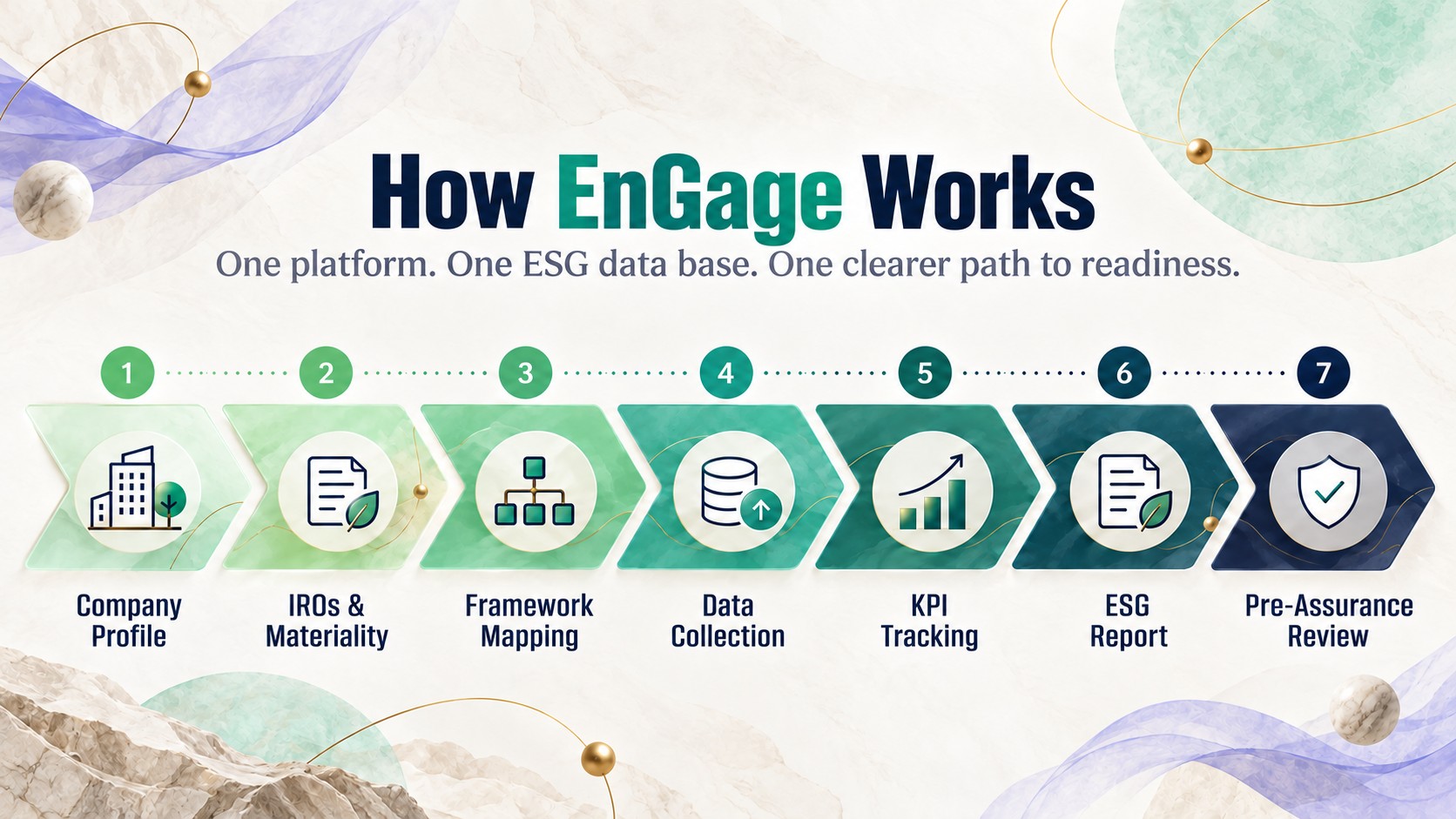
Yodiwo has added an AI-Powered Pre-Assurance Readiness Review to EnGage, its ESG Data Management and Reporting platform. EnGage already covers ESG compliance reporting, Double Materiality Assessment, carbon accounting, supplier management and ISO management. The review adds a final step: examining the completed report through an assurance lens.
It reviews a sustainability report prepared under ESRS or GRI and identifies, in minutes, the matters an assurance provider is likely to raise.
What the review tests
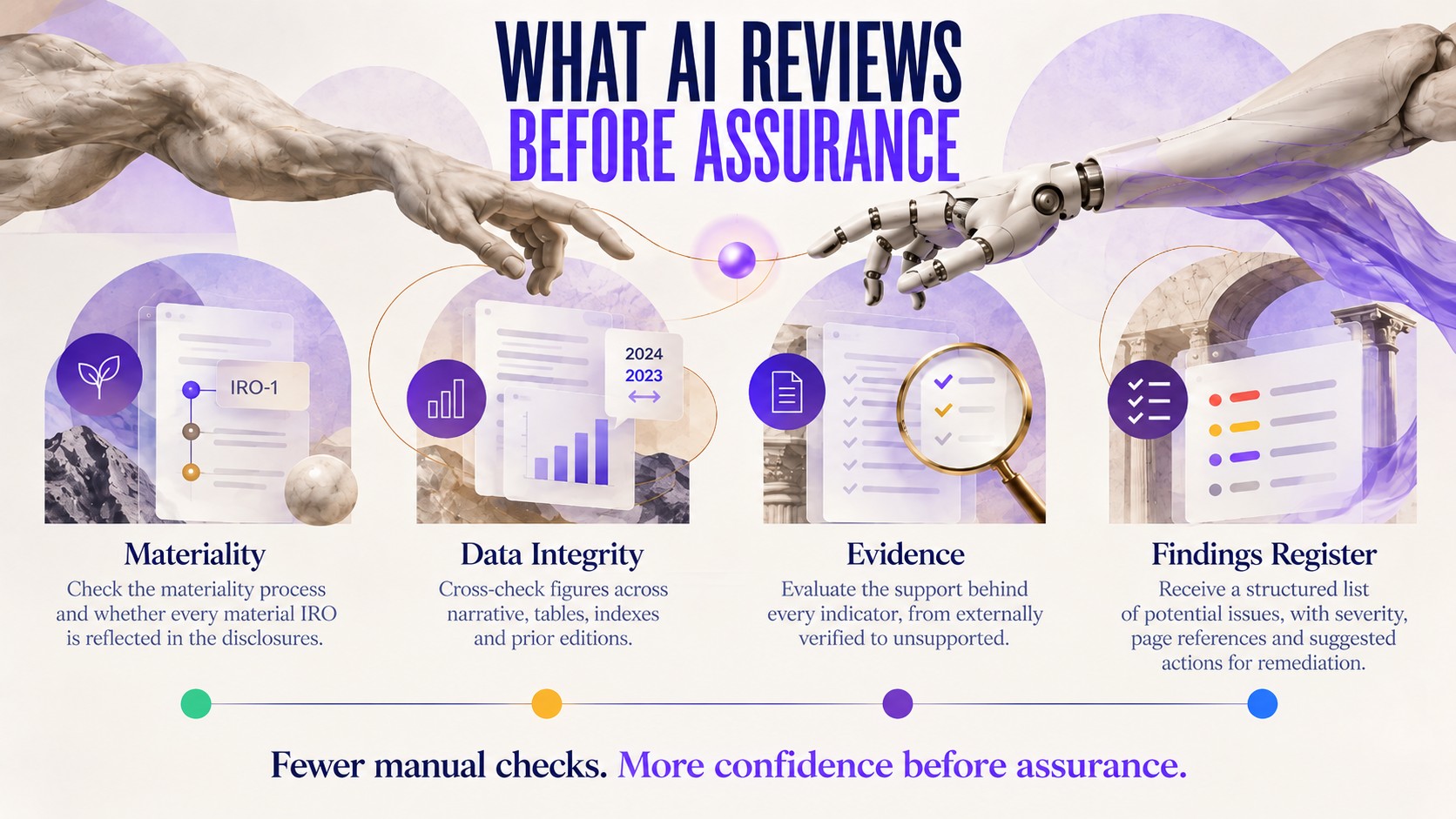
- Materiality: for ESRS, whether the double materiality process described in IRO-1 matches its outputs, covers the full consolidation scope and carries every material IRO through to a disclosure. For GRI, the equivalent checks on the GRI 3 material topics process.
- Data integrity: every figure is cross-checked across the narrative, the tables, the ESRS or GRI index and prior editions, with restatements traced and explained.
- Evidence: every indicator is graded on a five-level scale, from externally verified to unsupported. Estimates are checked for disclosed uncertainty as well as method.
- Connectivity: consistency with the financial statements and the management report.
- EU Taxonomy (Article 8): whether eligibility screening covers all activities in scope, whether turnover, CapEx and OpEx KPIs reconcile to the financial statements, and whether disclosures are complete per objective and consistent with ESRS E1–E5.
- Forward-looking information: whether targets are backed by adopted plans and disclose what could prevent their achievement.
- Assurance-specific matters: information incorporated by reference, comparatives, subsequent events and readiness for the management representation letter.
From findings to action
The review produces three outputs:
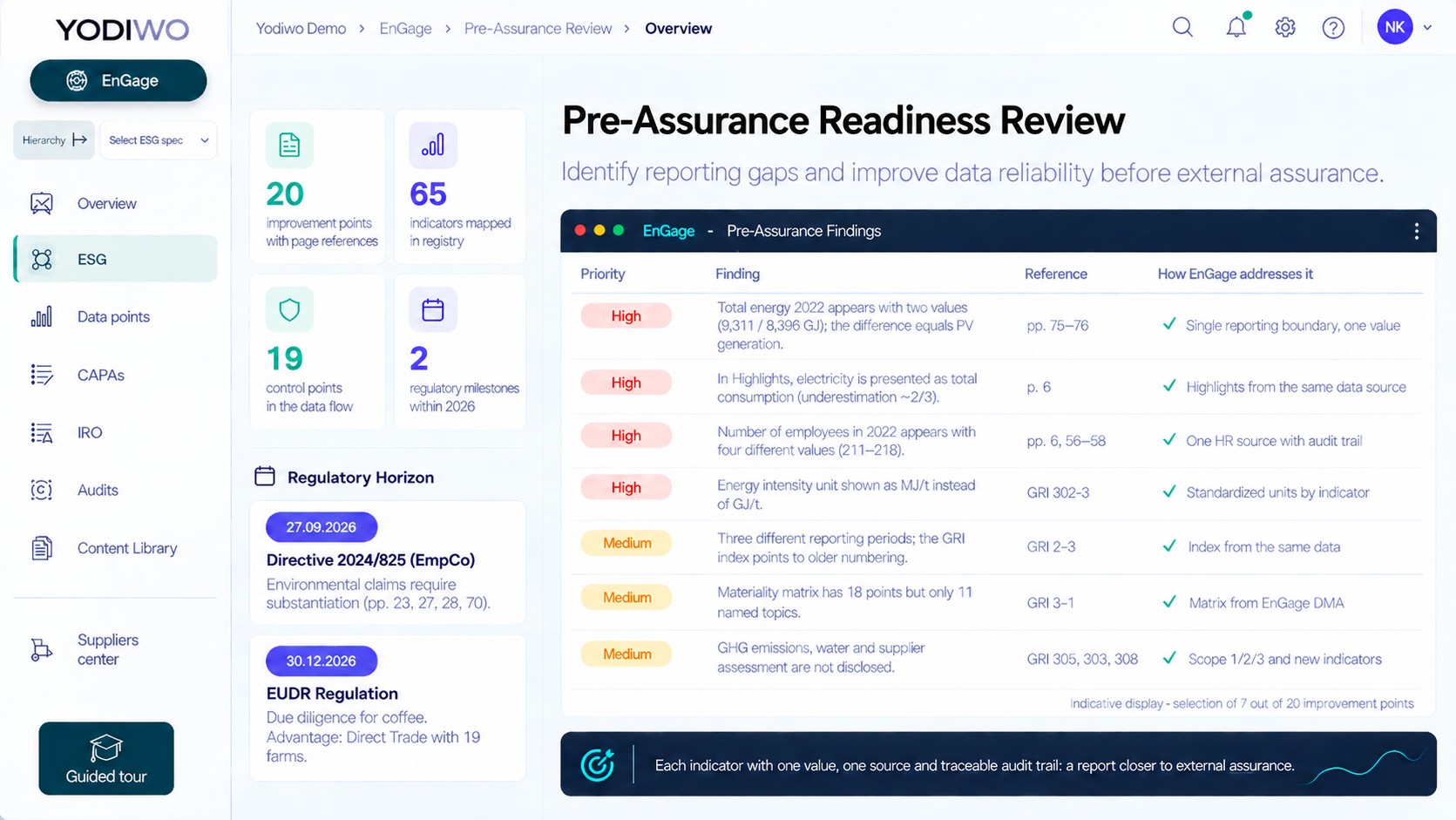
- A findings register: each finding classified as quantitative, qualitative, omission or process, with a severity, page reference and remediation step.
- An indicator register: the support behind each reported figure.
- A maturity profile: the areas that most limit assurance readiness.
Built on assurance logic
The checks are informed by the CEAOB limited assurance guidelines and the principles of ISSA 5000 and ISAE 3000. Every review includes a coverage matrix stating what was tested and what was not.
The review prepares for assurance; it does not replace it. It does not issue an assurance conclusion or override professional judgement. The assurance conclusion always remains with the independent assurance provider.
Less rework, more value across the ESG ecosystem
Reporting companies. The main benefit is timing. Findings that surface during fieldwork mean delays, late restatements and pressure on internal teams. The review brings those findings forward, when there is still time to fix them, and shows management where the report stands.
Sustainability advisors. The first pass on a client report, cross-checking the index against the narrative and tables, takes hours of repetitive work. The review delivers that first pass in minutes. Advisors can then focus on interpreting findings, guiding remediation and serving more clients.
Assurance providers. A client who has run the review arrives with clearer, traceable information and fewer gaps to chase. Practitioners can also use the review as a first-pass analysis within their own engagement, subject to their own procedures, applicable standards and professional judgement.
AI does not remove expertise from the process. It gives experts more time for the work that requires judgement.
The next chapter of ESG intelligence
The first generation of ESG technology made sustainability data easier to collect. The next turned that data into reports. Now AI helps organisations examine those reports before they reach independent assurance.
The best time to find a reporting gap is before your assurance provider does. The future of ESG reporting is not only about producing disclosures faster. It is about knowing which questions to ask before someone else does.
Book a demo and see what a findings register looks like for your report.