What if a company could give 4,500 people a great workplace experience without maintaining 4,500 individual desks?
The answer is not squeezing more people into smaller offices. It is rethinking how workplaces are designed, shared and managed.
Hybrid work once meant flexibility. Today, it also means real estate efficiency, employee wellbeing and sustainability. Every underused floor, unnecessarily heated office and avoidable commute has a cost, both financial and environmental.
At Yodiwo, we believe the future of hybrid work is not simply about where people work. It is about how intelligently organisations use their resources.
Hybrid vs. Remote vs. On-Site: What Does the Latest Research Show?
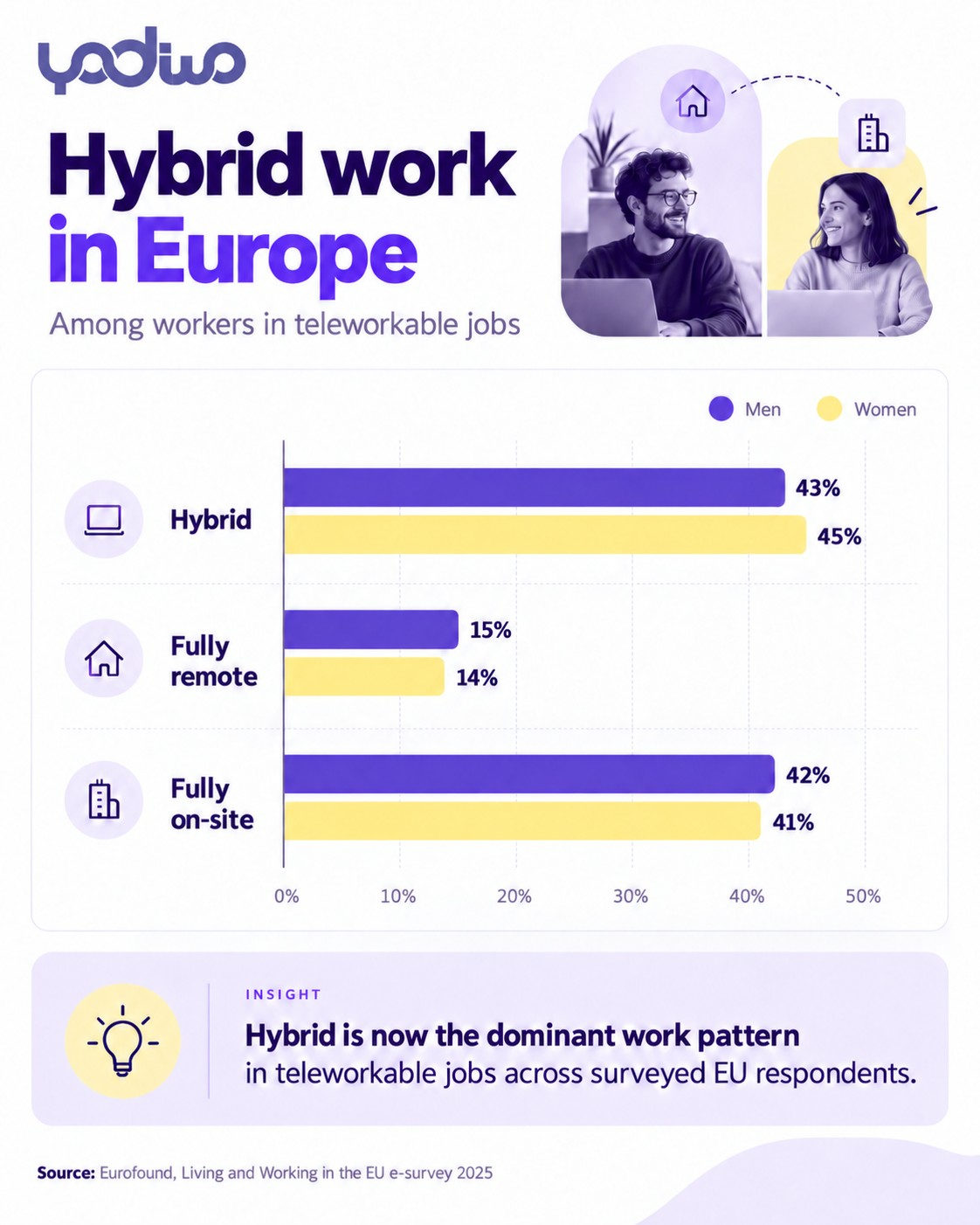
Hybrid work combines remote and on-site working days, offering employees flexibility while preserving opportunities for face-to-face collaboration.
According to Eurofound’s 2025 Living and Working in the EU e-survey, hybrid working has become the dominant arrangement among surveyed men and women in teleworkable jobs. The findings also highlight increasing demand for regular remote work.
In the United States, Gallup’s 2026 data show that, among employees with remote-capable jobs:
- 52% work in a hybrid arrangement.
- 26% work fully remotely.
- 22% work entirely on-site.
What about company policies?
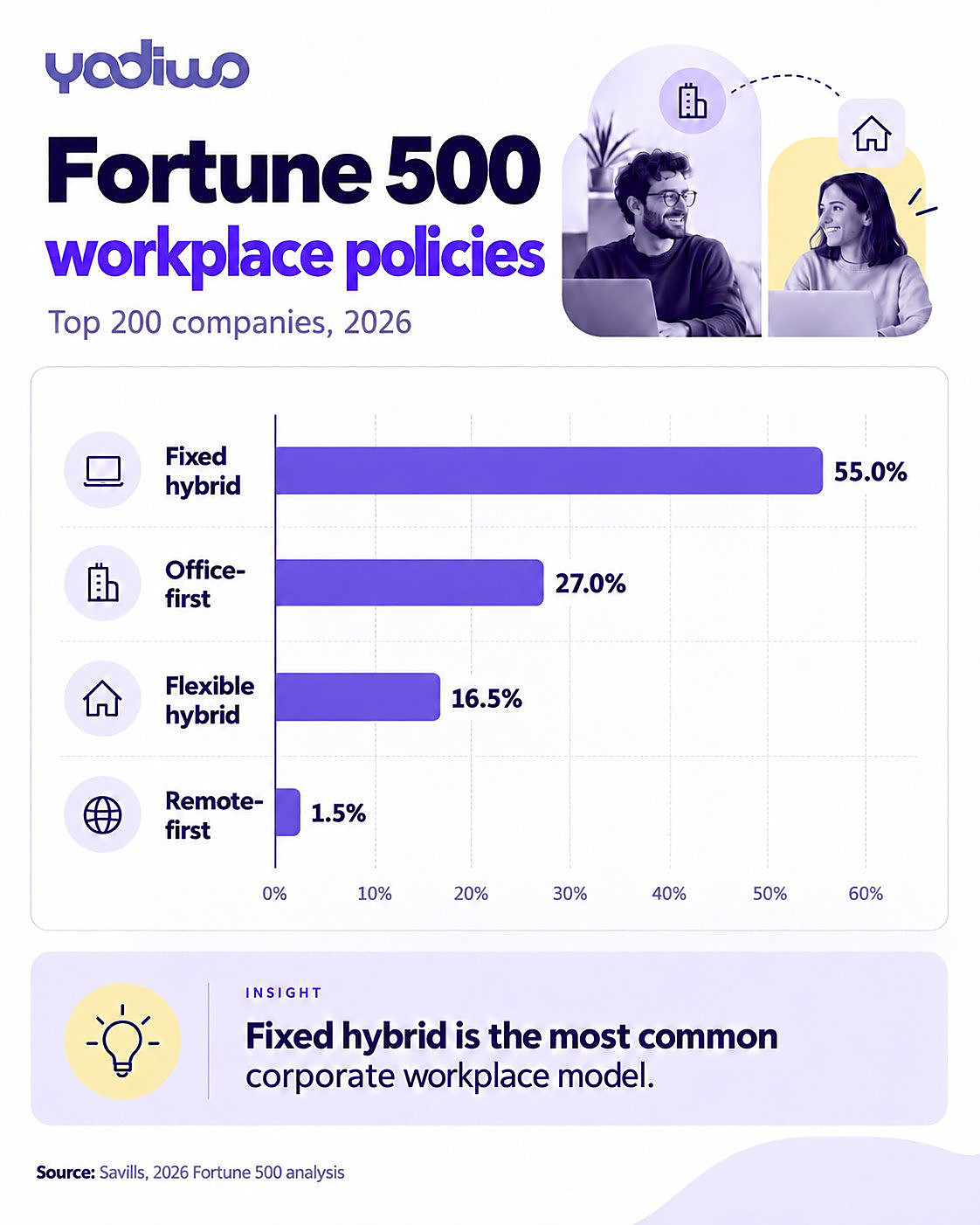
A 2026 Savills analysis of the top 200 Fortune 500 companies found that 55% follow fixed hybrid arrangements, 16.5% offer flexible hybrid policies, 27% are office-first and just 1.5% are remote-first.
These categories reflect different populations and policies, rather than a single global distribution. But they tell a consistent story: hybrid working has become an established business model.
The Future of Hybrid Work: What Can We Expect?
The next phase is not necessarily about working from home more often. It is about making existing hybrid arrangements more effective. 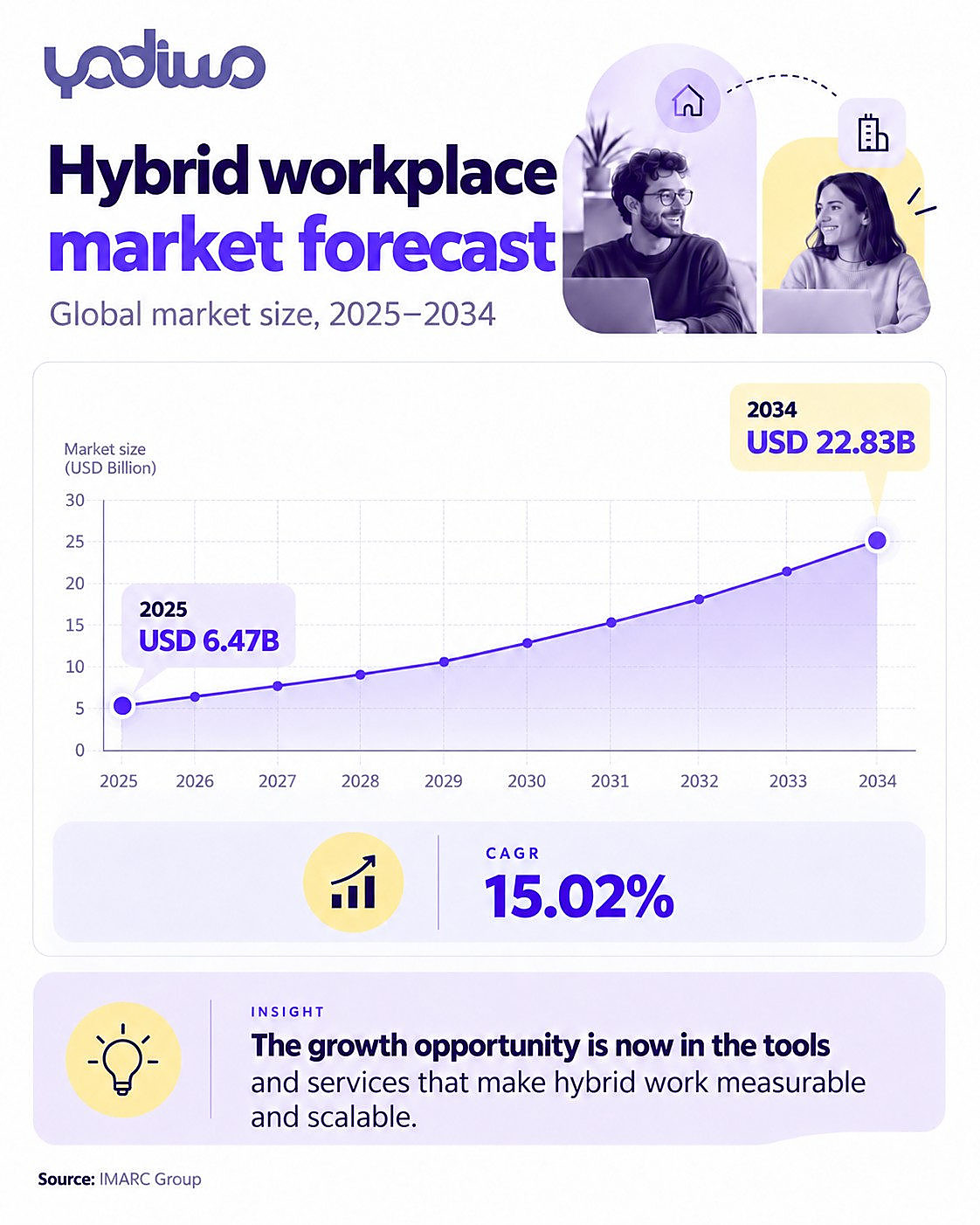
Companies are reassessing their office requirements, introducing smarter scheduling policies and investing in digital workplace management. According to IMARC Group, the global hybrid workplace market is projected to grow from $6.47 billion in 2025 to $22.83 billion by 2034, representing a compound annual growth rate of 15.02%.
This forecasts spending on hybrid workplace solutions and services, not the percentage of employees who will work remotely. The emerging priority is clear: making hybrid workplaces measurable, sustainable and employee-friendly.
Why Hybrid Work Benefits Employees and Businesses
The advantages extend beyond avoiding traffic.
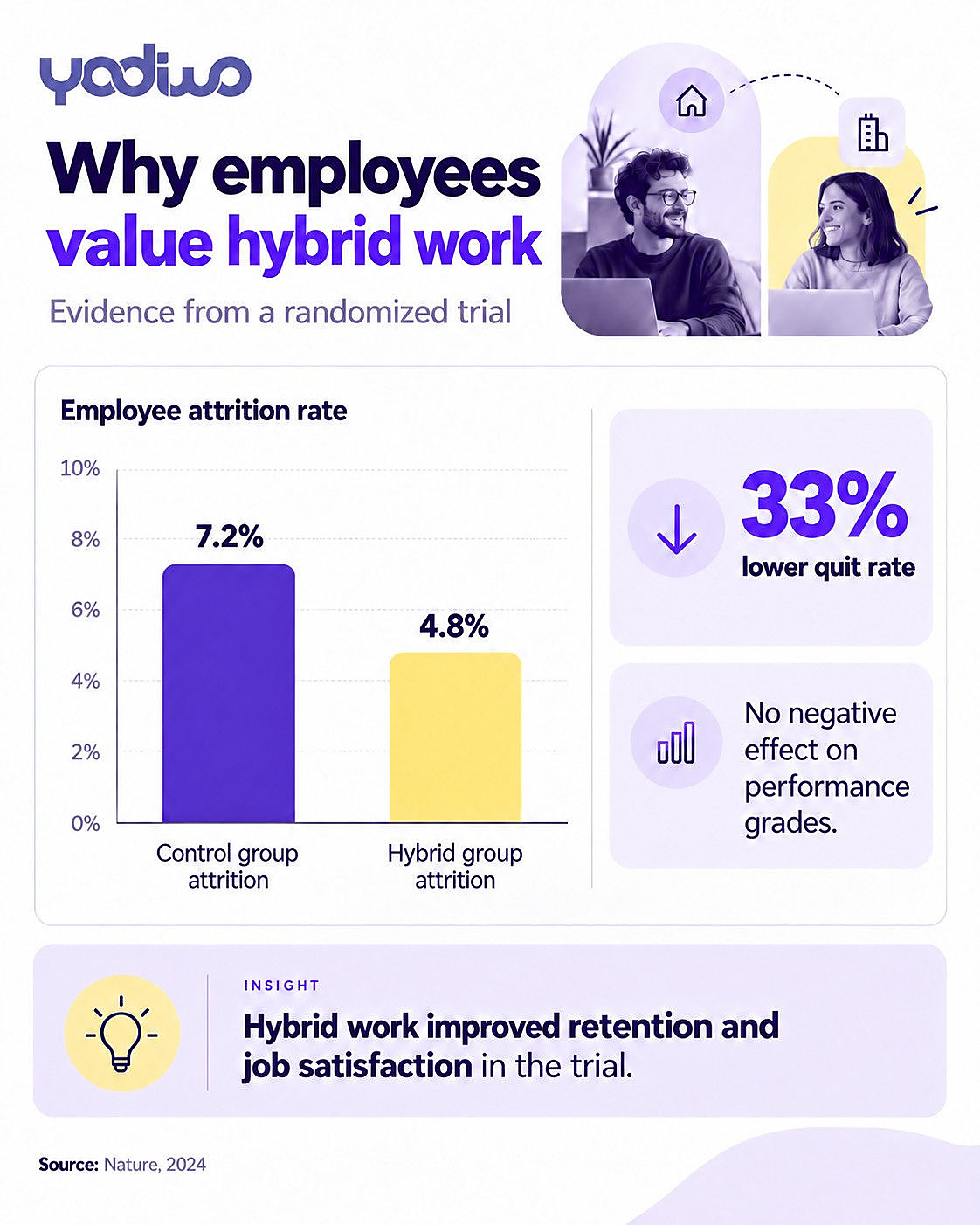
For employees, hybrid work can mean reduced commuting costs, better work-life balance, greater autonomy and more opportunities for focused work. For organisations, it can support employee retention and satisfaction.
A 2024 study published in Nature, involving 1,612 employees, found that working from home two days per week reduced resignation rates by approximately one-third without damaging measured performance.
But flexibility alone does not guarantee a positive employee experience. When several thousand people share fewer workstations, a new challenge emerges: ensuring everyone has access to suitable workspace when they need it.
This is where hybrid working becomes a workplace management challenge.
A Real Yodiwo Customer Case: 4,500 Employees, 3,000 Desks
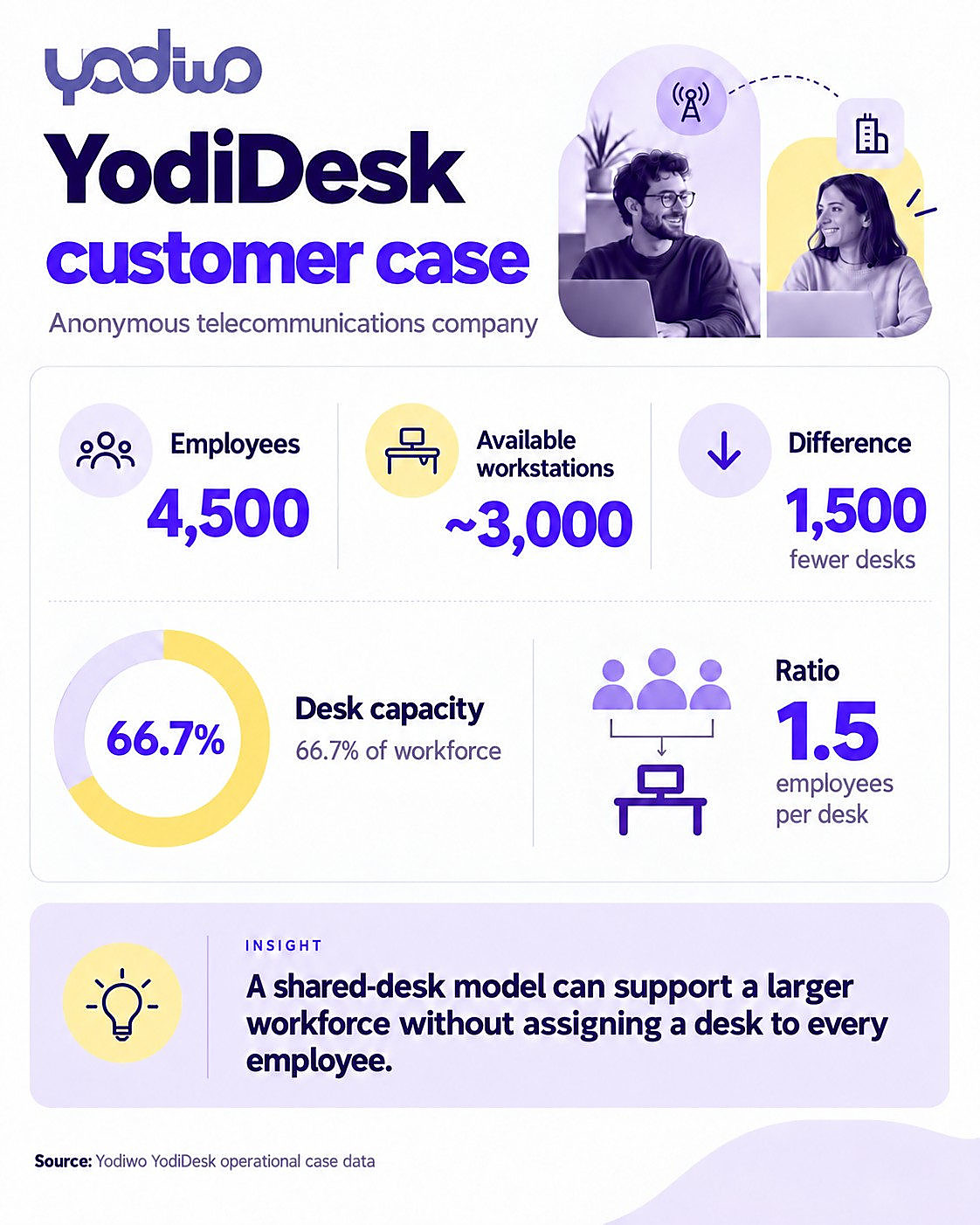
Consider a large telecommunications company using Yodiwo’s YodiDesk workplace booking application.
Although the customer’s identity remains confidential, the operational figures come from a real implementation: 4,500 employees sharing approximately 3,000 available workstations. That is 1,500 fewer desks than would be required in a traditional one-desk-per-employee arrangement.
In practical terms, the company operates with desk capacity equivalent to approximately two-thirds of its workforce. This does not mean the same 1,500 people always work remotely. Employees rotate their office attendance, making intelligent workspace allocation essential.
The result is a different approach to office infrastructure: instead of providing a permanently assigned desk for every employee, the company can coordinate shared resources according to demand.
And the potential financial implications are substantial.
How Much Office Space Can Hybrid Working Save?
Let’s translate the desk-capacity difference into square metres. The British Council for Offices identified an effective planning density of approximately 15 m² per office occupant in its 2025 research. 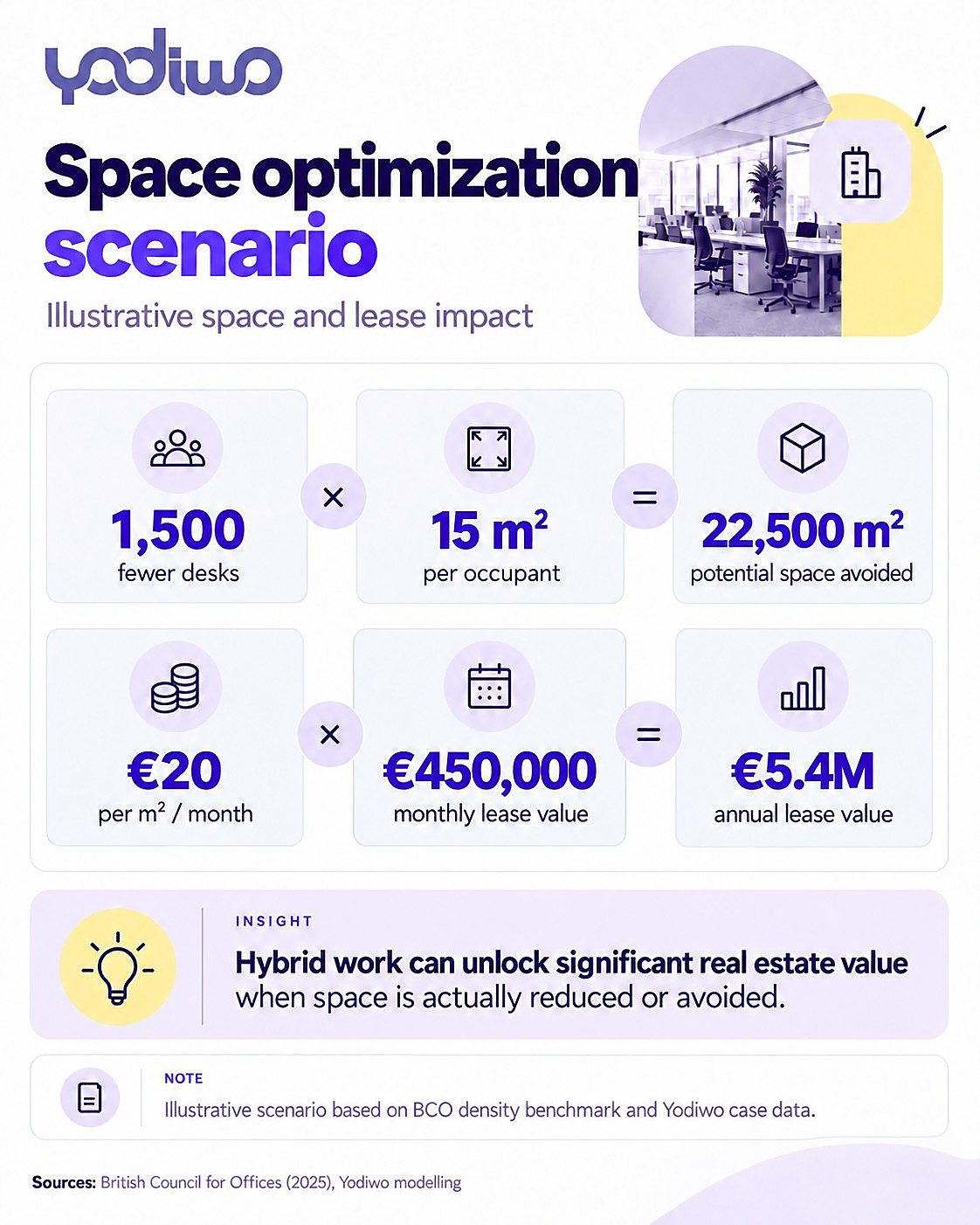
Using this as an illustrative space-planning assumption:
1,500 workstations × 15 m² = 22,500 m²
That represents 22,500 m² of potentially avoidable office space compared with accommodating every employee at an individual workstation.
Now consider the financial implications. At an assumed monthly lease cost of €20 per square metre:
22,500 m² × €20 = €450,000 per month
That becomes €5.4 million in potential annual leasing costs.
These are scenario estimates rather than verified customer savings. The financial benefit materialises when organisations actually avoid leasing additional space or reduce their existing footprint. But the opportunity does not end with rent.
The Hidden Energy Cost of Office Space
Buildings consume energy regardless of whether their desks are fully occupied.
Lighting, air conditioning, heating and office equipment contribute to operating costs and environmental impact. Research into Greek commercial office buildings illustrates the scale. A study by Spyropoulos and Balaras, published in Energy and Buildings, reported average annual total energy consumption of approximately 345 kWh/m² across the bank branches studied. Energy requirements vary significantly depending on a building’s age, systems, location and efficiency.
For our scenario, let us use an illustrative 275 kWh/m² annually for total final energy consumption.
For 22,500 m², the calculation is:
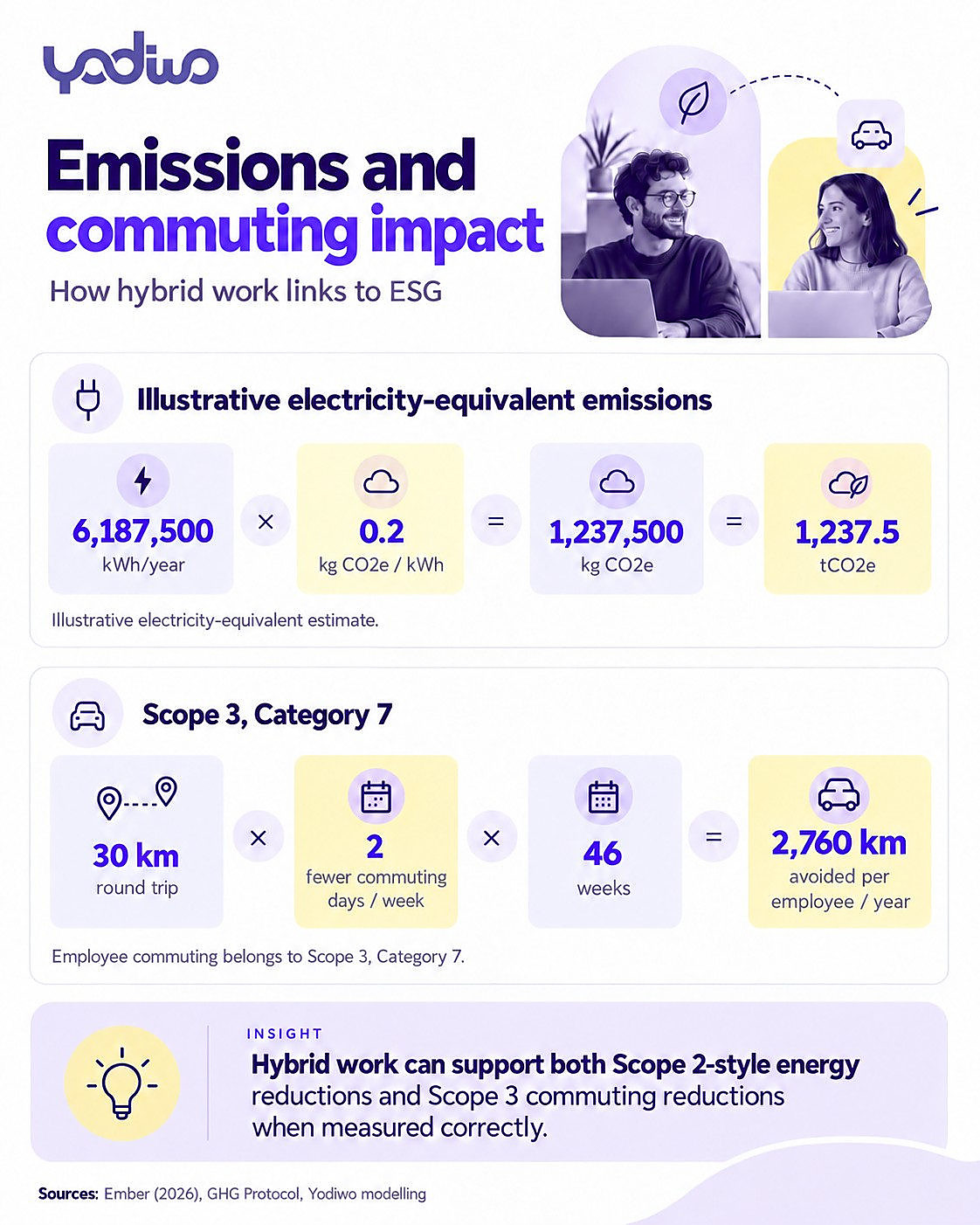
22,500 × 275 = 6,187,500 kWh annually
Applying a simplified average energy price of €0.15 per kWh gives:
6,187,500 × €0.15 = €928,125 annually
Combined with the potential leasing benefit, this represents approximately €6.33 million in annual avoidable costs.
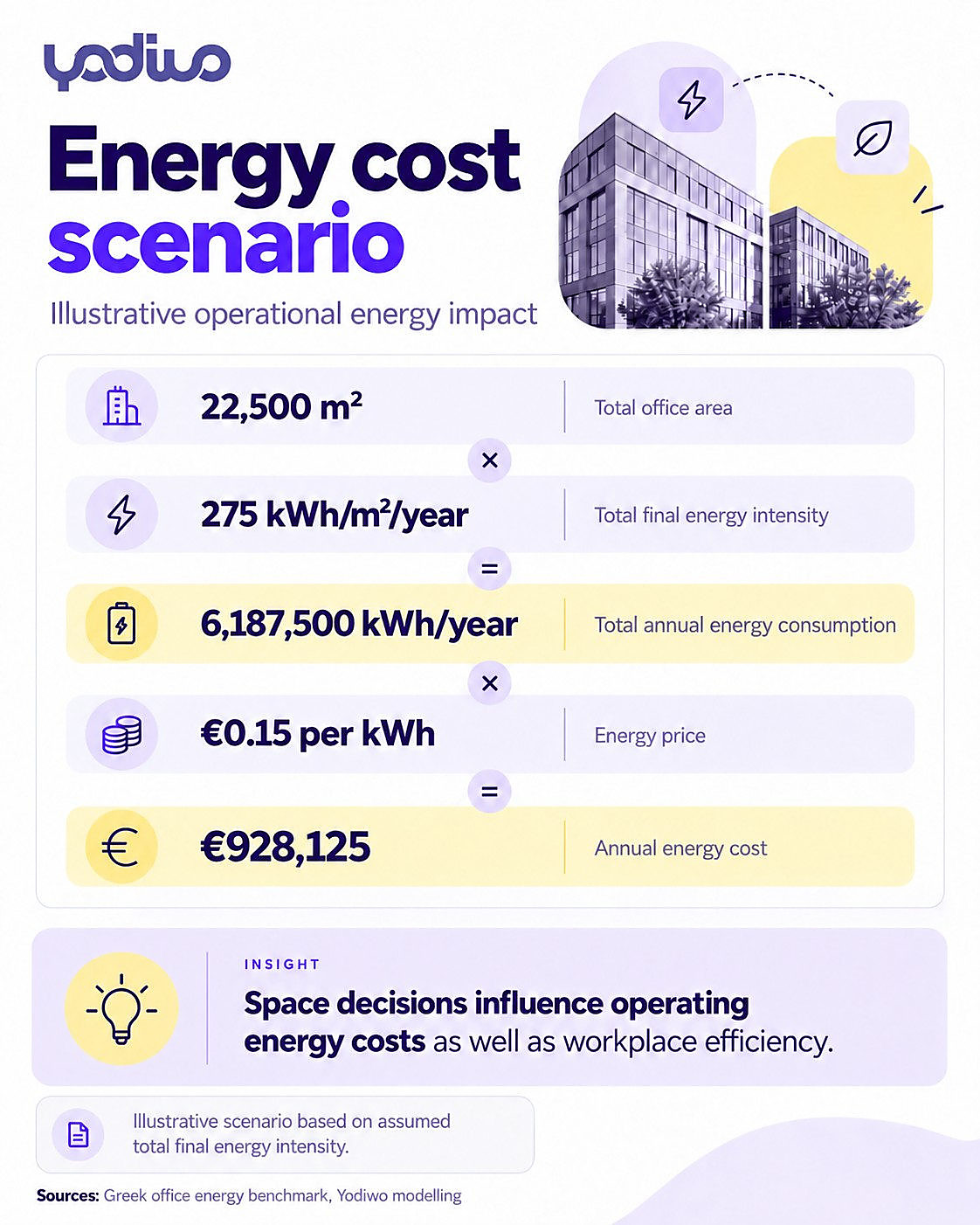
The energy calculation assumes the full corresponding floor area is no longer required and uses a simplified blended energy price. Actual costs will depend on the electricity-heating mix, tariffs and building operation.
The broader lesson is simple: smarter space management can create value far beyond the desk itself.
Hybrid Work and ESG: How Can It Reduce Scope 2 Emissions?
The environmental implications are equally important. According to the GHG Protocol, Scope 2 covers indirect emissions associated with purchased electricity, steam, heating and cooling. When an organisation genuinely reduces its operational footprint and purchased electricity consumption, it can reduce the associated Scope 2 emissions.
How significant could this be?
Ember’s Global Electricity Review 2026 estimates that EU electricity generation emitted approximately 210 gCO₂e/kWh in 2025.
Using a rounded illustrative factor of 0.2 kg CO₂e per kWh, our scenario produces:
6,187,500 kWh × 0.2 kg CO₂e/kWh = 1,237,500 kg CO₂e
That equals approximately 1,238 tonnes of CO₂e annually.
This figure illustrates the potential electricity-related emissions associated with that energy volume if it were entirely purchased grid electricity. Because the 275 kWh/m² assumption represents total final energy, including heating, this is not a verified Scope 2 reduction for the customer. Where heating uses fuel burned on-site, those emissions generally fall under Scope 1. Accurate reporting requires separating energy sources and applying the relevant national, supplier-specific or contractual factors. Nevertheless, the calculation demonstrates the environmental scale that office-space decisions can influence.
Scope 3, Category 7: The Carbon Footprint of Employee Commuting
Office buildings are only part of the sustainability equation.
Every journey to and from the workplace also has an environmental footprint. Under the GHG Protocol, employee commuting belongs to Scope 3, Category 7. Hybrid working can reduce these emissions by decreasing commuting frequency. Consider an employee travelling 30 kilometres round trip. If hybrid working eliminates two commuting days per week over 46 working weeks, that represents:
30 km × 2 days × 46 weeks = 2,760 fewer kilometres annually.
To calculate emissions avoided, organisations must consider transport modes and appropriate emission factors. Working from home also uses energy, so a complete assessment should account for additional household consumption where relevant.
The key opportunity is measurable rather than automatic: fewer journeys, less energy-intensive commuting and better-informed workplace decisions.
How YodiDesk Helps Turn Hybrid Policies into Smarter Workplaces
For companies implementing hybrid work, reduced desk capacity is only practical when supported by reliable workplace management.
Employees need to find and reserve workstations. Teams need to coordinate office days. Facilities managers need to understand occupancy patterns and anticipate demand. YodiDesk supports this through real-time desk availability, reservations, interactive workplace maps, check-in functionality and utilisation insights. These capabilities help organisations manage shared workspaces while improving the daily employee experience. Combined with appropriate energy and commuting data, workplace utilisation insights can also support better-informed ESG decisions.
For an organisation serving 4,500 employees with around 3,000 workstations, intelligent booking is not simply a convenience. It helps make the entire hybrid operating model possible.
The Future of Sustainable Work Is About Using Space Better
The next sustainable office is not necessarily a bigger office—or even a fully remote one. It is an office that matches real employee needs, avoids unnecessary space requirements and supports informed resource decisions. Hybrid working creates an opportunity to connect three business priorities: financial efficiency, employee experience and environmental responsibility.
The most useful question for business leaders may no longer be:
“How much office space do we need for our employees?”
But rather:
“How intelligently are we using the space we already have?”
At Yodiwo, we believe that is where hybrid work meets its true potential: smarter workplaces, better experiences and sustainability outcomes that can actually be measured.