July 2026 – a practical comparison of the carbon calculator tools SMEs actually shortlist, grouped by how you start and what you can get for free, then compared on method, features and pricing.
More and more SMEs are being asked to measure and report their carbon emissions – by their banks, their largest customers, and the tender processes they bid into, often at short notice. Measuring a footprint means accounting for emissions across three standard groups: Scope 1 (what you burn directly), Scope 2 (the energy you buy), and Scope 3 (everything in your supply chain), to the GHG Protocol, the global standard.
The real question is how to produce that number and actually a report you can actually hand over. This guide compares eight Carbon Calculator tools plus the free and manual routes most SMEs try first.
Manual and free methods vs dedicated software
Most SMEs start with one of two low-cost routes.
Spreadsheets from scratch give full control and zero licence cost, but you carry the whole burden – knowing which emission factors apply, building the formulas, keeping the method consistent, and formatting an output a bank will accept. Slow, error-prone, and hard to repeat.
Free calculators – the SME Climate Hub’s Business Carbon Calculators and Denmark’s government-run Climate Compass are the best examples – are a genuinely useful starting point: no cost, all three scopes, and a downloadable summary. The limits are the point, though: the simplest ones estimate from what you spend (directionally accurate, good for spotting hotspots, not a precise supplier-level number), and they produce an estimate rather than a formal, auditable compliance report.
Dedicated software goes a step further: the low effort of a guided carbon calculator tool, the expertise an SME lacks, a report to a named standard, and saved data so next year is a quick update.
| Spreadsheet | Free calculator | Carbon tool | |
| Up-front cost | None | None | Low–medium |
| Time to first footprint | Weeks | Hours–days | Hours–days |
| Carbon expertise needed | High | Low–medium | Low |
| Method / accuracy | Depends on you | Estimate (often spend-based) | Activity-based available |
| Named emission factors | Manual | Partial | Yes |
| Formal compliance report | Manual | No (estimate) | Yes |
| Year-over-year reuse | Manual | Limited | Yes |
Carbon tools at a glance
Read down a column for one tool, or across a row for one capability. Grouped roughly by how you pay: build-and-pay-per-report, free, then subscription/trial/demo-led.
| Carbon Calculator Tool | How you start | Free report? | Method | Scopes | Report standard | Multi-company | Pricing model |
| Yodiwo | Self-serve, instant | ○ build free, pay to calc | Activity | 1·2·3 | GHGP + CSRD/ESRS E1 | ✓ up to 5 | Pay-per-report (€550) |
| Persefoni Pro | Self-serve | ○ footprint free; report paid | Activity (+est.) | 1·2·3 | GHGP + PCAF | ○ supplier portal | Free; report/Advanced paid |
| Sustrax Lite | Self-serve | ✓ free (capped) | Activity | 1·2·3* | GHGP + ISO 14064 | ○ higher tiers | Free tier + sub (£296/yr+) |
| Compare Your Footprint | Register / demo-gated | – pay first | Activity | 1·2·3 | GHGP (Excel/PDF) | ○ quote | Subscription £958+/yr |
| GoClimate | Connect books / demo | – subscription | Spend-first | 1·2·3 +S&G | GHGP (loc.+mkt.) | ○ Enterprise | Sub by entries (SEK) |
| Sage Earth | Inside Sage Accounting | ○ dashboard; needs Sage | Spend (+activity) | 1·2·3 | GHGP dashboard | ✓ accountants | Add-on to Sage (£18+/mo) |
| Seedling | Self-serve free / demo | – free = hotspot only | Spend → activity (paid) | 1·2·3 | GHGP; PPN/B-Corp/SECR | ○ sites (paid) | Free hotspot; report by quote |
Legend: ✓ = yes / supported · ○ = partial, capped, or only on a paid tier · – = no / not the model · ? = not publicly confirmed · * Sustrax Lite’s free tier caps records and locks some Scope 3 categories. GHGP = GHG Protocol · S&G = also covers social & governance · loc.+mkt. = location- and market-based Scope 2.
Quick picks
- Build free carbon calculator, pay once for the report: Yodiwo (pay-per-report, €550, no subscription) and Persefoni Pro (free footprint, pay to unlock the formal report) -the only tools here that charge for the output rather than a recurring subscription.
- Most accurate method with named factors: Yodiwo, Compare Your Footprint and Sustrax Lite – all activity-based, all name their factors.
- Least typing (automatic from your books): Sage Earth (if you use Sage) and GoClimate – at the cost of a spend-based baseline.
The best carbon accounting software in 2026
1. Yodiwo Carbon Emission Calculator
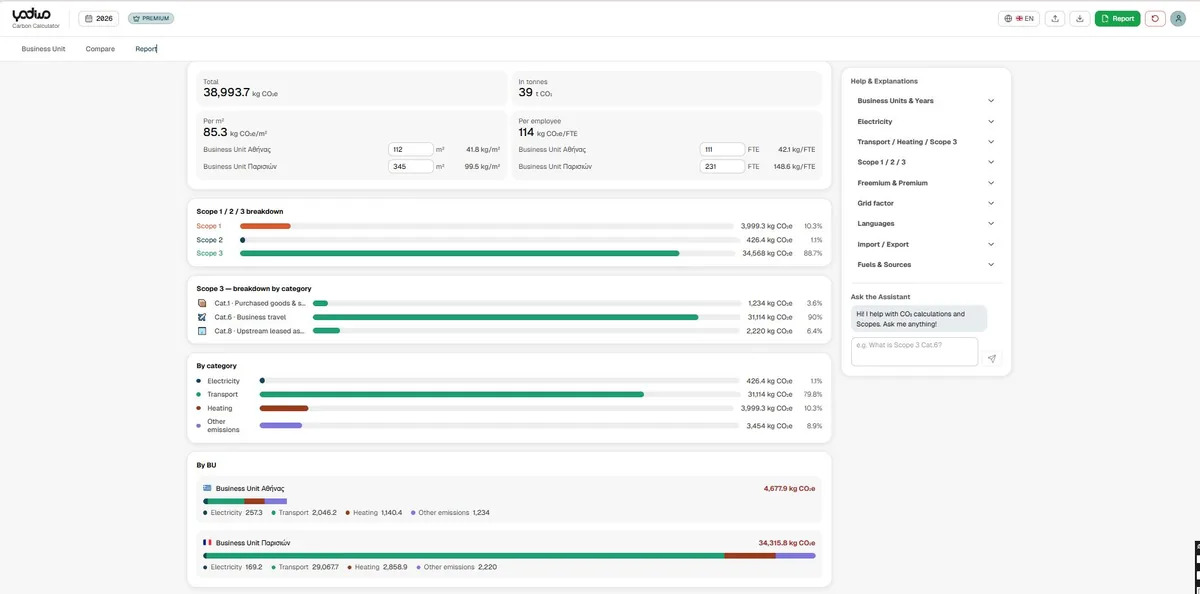
What it is – A self-serve carbon calculator that turns the activity data you already have – electricity, fuel, transport, waste, suppliers – into a complete Scope 1–3 footprint and a ready-to-use report, with no carbon background needed. Part of Yodiwo’s DIY Sustainability Marketplace.
Key features
- Instant, cloud-hosted access – sign up and start in minutes, no IT project, demo or sales call
- Activity-based method with named factors (EEA, IEA, IPCC); all three scopes, broken down by source, category, location and business unit
- Free to build and edit all your data; you pay only at the point of calculation
- Report to the GHG Protocol, aligned with the EU’s CSRD/ESRS E1 climate standard, plus a Greek National Climate Law report for home-market use
- Multi-company (up to five, each with its own data and report) and year-over-year carryover – useful for consultants and groups
What sets it apart – Yodiwo is the strongest fit for an SME that wants an accurate number, a report to a recognised standard, and no ongoing subscription. It’s genuinely self-serve and pay-per-report – build your full inventory for free and pay only when you generate the report – it’s activity-based with named factors, and it scales straight into Yodiwo’s EnGage platform (automated data from ERP, IoT and sensors; CSRD/ESRS, GRI, CDP, ISSB) when you outgrow self-serve, with your data carried over.
Pricing – Free to enter and edit data; you pay at calculation. €550 covers one company’s annual report with two-year access; €1,500 covers up to five companies (aimed at consultants and multi-entity groups), also two-year access. No subscription, no accounting-software lock-in.
For an SME, consider – At the self-serve tier, data entry is manual – automatic import from accounting systems and AI document-reading come with the EnGage upgrade – and there’s no sector benchmarking against peers today. If you need automated data feeds or full CSRD/GRI/ISSB reporting now, EnGage is the right entry point rather than the DIY tool.
Best for – SMEs answering bank, client and tender carbon requests; finance and operations teams without carbon expertise; and consultants running footprints for several clients.
You can try it free at DIY Sustainability Marketplace – build your footprint at no cost, then pay only to calculate and export your report.
2. Persefoni Pro
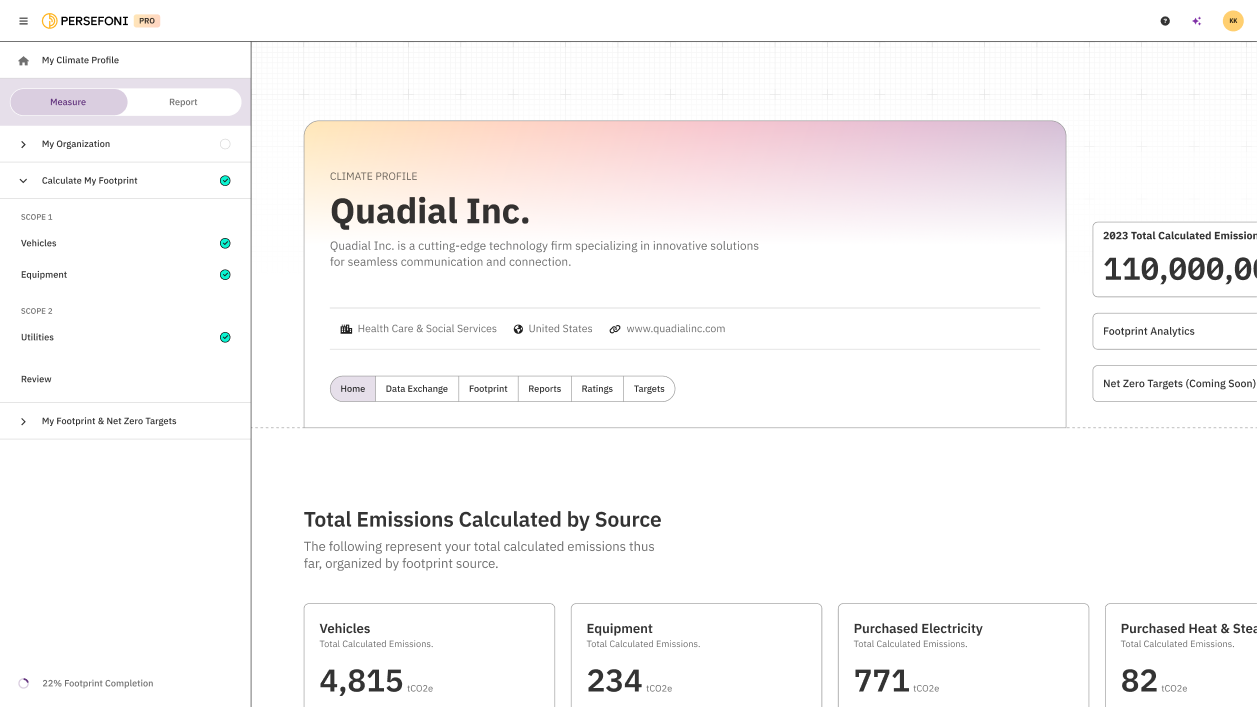
What it is – The free “Pro” tier of a larger carbon-accounting platform, built to measure your footprint and answer customer and investor requests (CDP, EcoVadis). US-headquartered; TIME named Persefoni a top GreenTech company of 2026.
Key features
- You send your work mail and if it is accepted you get Free and self-serve – start with no credit card and no demo (the larger “Advanced” platform needs a sales demo)
- All three scopes to the GHG Protocol (and PCAF for financed emissions); activity-first, with rough estimates as a fallback
- A free AI assistant (“Copilot”) flags figures that look wrong and, new in 2026, answers plain-language questions and auto-generates charts; a climate expert reviews your Scope 3 at no cost
- Granular life-cycle data (ecoinvent) and a downloadable, audit-ready “Carbon Ledger”
Pricing – Pro is free. The detailed breakdowns and formal metrics report are paid upgrades; the Advanced platform is priced on request after a demo. The only published prices are Persefoni’s done-for-you US California compliance services (from $25,000), aimed at large US companies.
For an SME, consider – Measuring is free, but the report-ready breakdowns and formal report are paid, and prices above the free tier aren’t published. It’s US-focused, with no Greek or EU local-law report.
Best for – SMEs answering customer and investor questionnaires who want a free footprint with a built-in AI assistant and a clear upgrade path.
3. Sustrax Lite
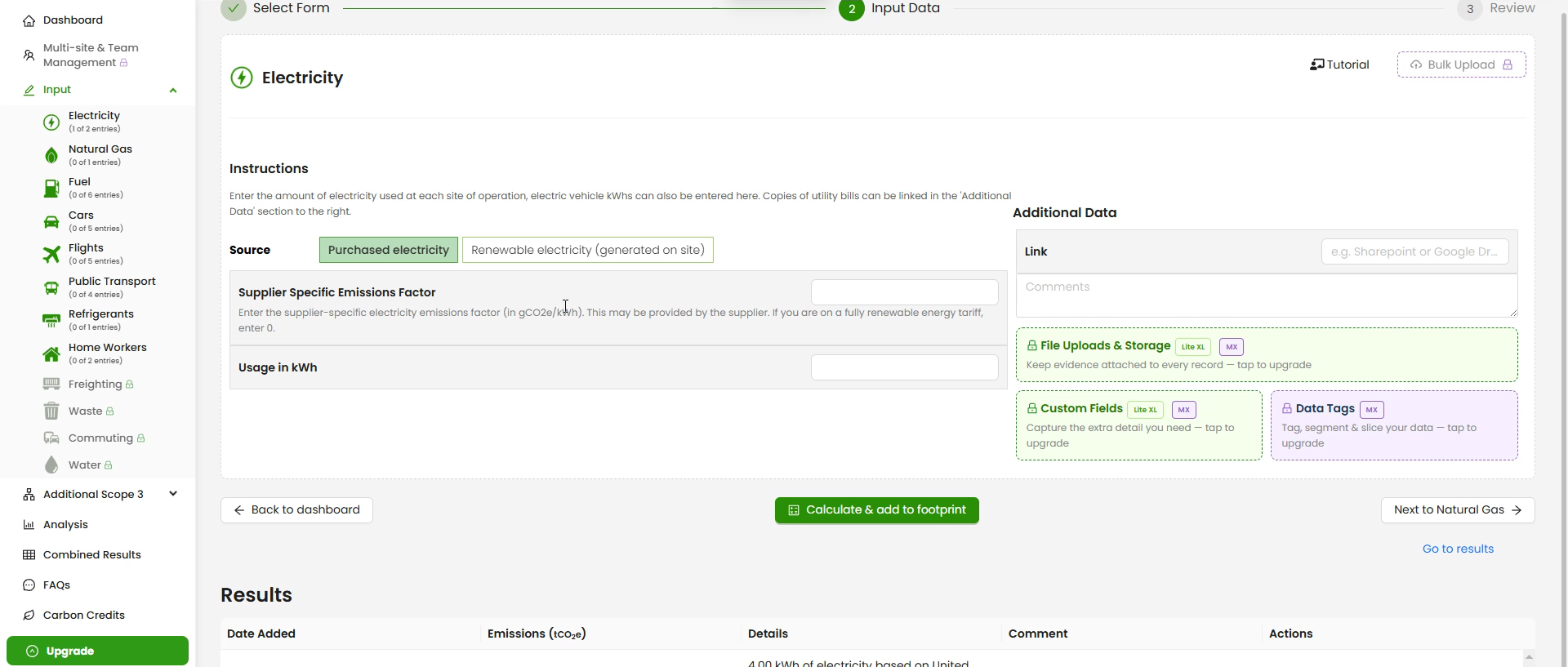
What it is – The free tier of Sustrax, the carbon platform from Carbon Footprint Ltd (20+ years of UK carbon consultancy). You sign up yourself and enter activity data to get a footprint and a downloadable PDF report.
Key features
- Self-serve; activity-based Carbon Calculator, GHG Protocol and ISO 14064 aligned, with a downloadable PDF report even on the free tier
- AI recommendations, year-on-year tracking, and an in-platform carbon-offset marketplace
- A clear upgrade path (Lite X/XL, then AX/MX enterprise) as you need more capacity
Pricing – Free tier available; paid tiers add capacity – Sustrax Lite X from £296/year (ex VAT), Lite XL higher, and AX/MX enterprise on request.
For an SME, consider – The free tier is capped: hard limits on records (e.g. up to five flights or vehicles), several Scope 3 categories (freight, water, waste, commuting) locked, a single user, limited AI uses and no bulk upload – you lift these by moving to a paid annual subscription. It’s UK-rooted.
Best for – Smaller or single-site businesses that want a real, downloadable activity-based report for free, with room to grow into paid tiers.
4. Compare Your Footprint
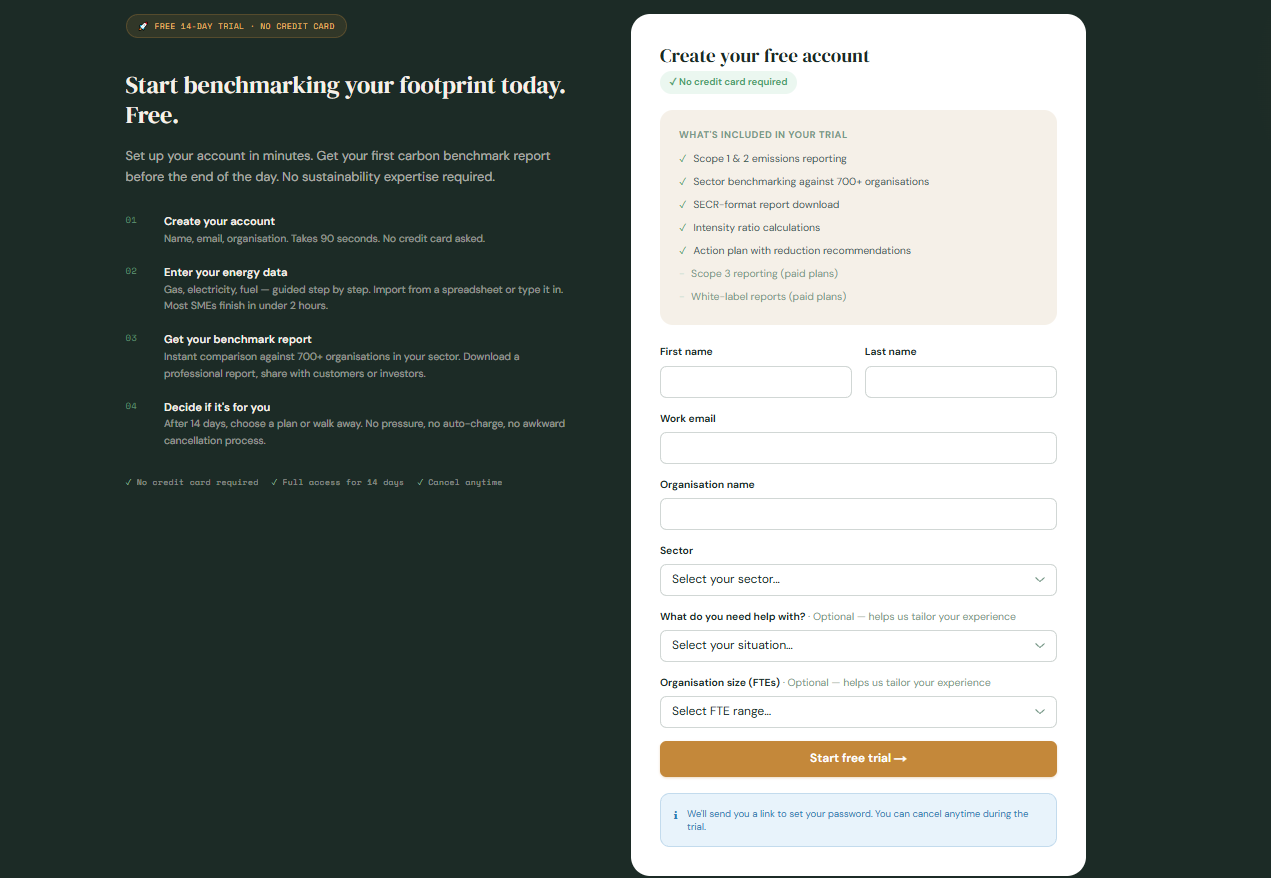
What it is – An activity-based footprint platform built by carbon experts, with worldwide coverage and prices published openly. UK-rooted.
Key features
- All three scopes from real activity data – energy, water, waste, travel, freight, materials and more – worldwide, in 100+ currencies
- UK government (DEFRA) factors plus a region-specific supply-chain model, and a “Carbon Factors Exposed” feature showing how each figure was worked out
- Audit-ready annual report (Excel and PDF) usable for CSRD, SECR and CDP; unlimited users; group and consultant/white-label options
How you start – Not instant self-serve: you register first, and the flow is gated – businesses over £1m turnover are invited to a discovery meeting, while smaller ones are emailed setup instructions. The sign-up screen prices you by turnover band and asks you to “register and pay” before you begin.
Pricing – An annual subscription scaling with turnover, from around £958/year (under £5m) up to £59,999/year (£1bn+). UK SECR reporting from £1,999 + VAT (free the first year if you subscribe). B-Corp discounts.
For an SME, consider – It’s registration/demo-gated with no free tier and no pay-per-report option, and it’s UK-rooted (DEFRA factors, UK SECR); the independent ISO 14064-3 audit is arranged separately.
Best for – UK-facing SMEs that want an activity-based tool with transparent factors and open pricing, and are ready to commit to an annual subscription.
5. GoClimate
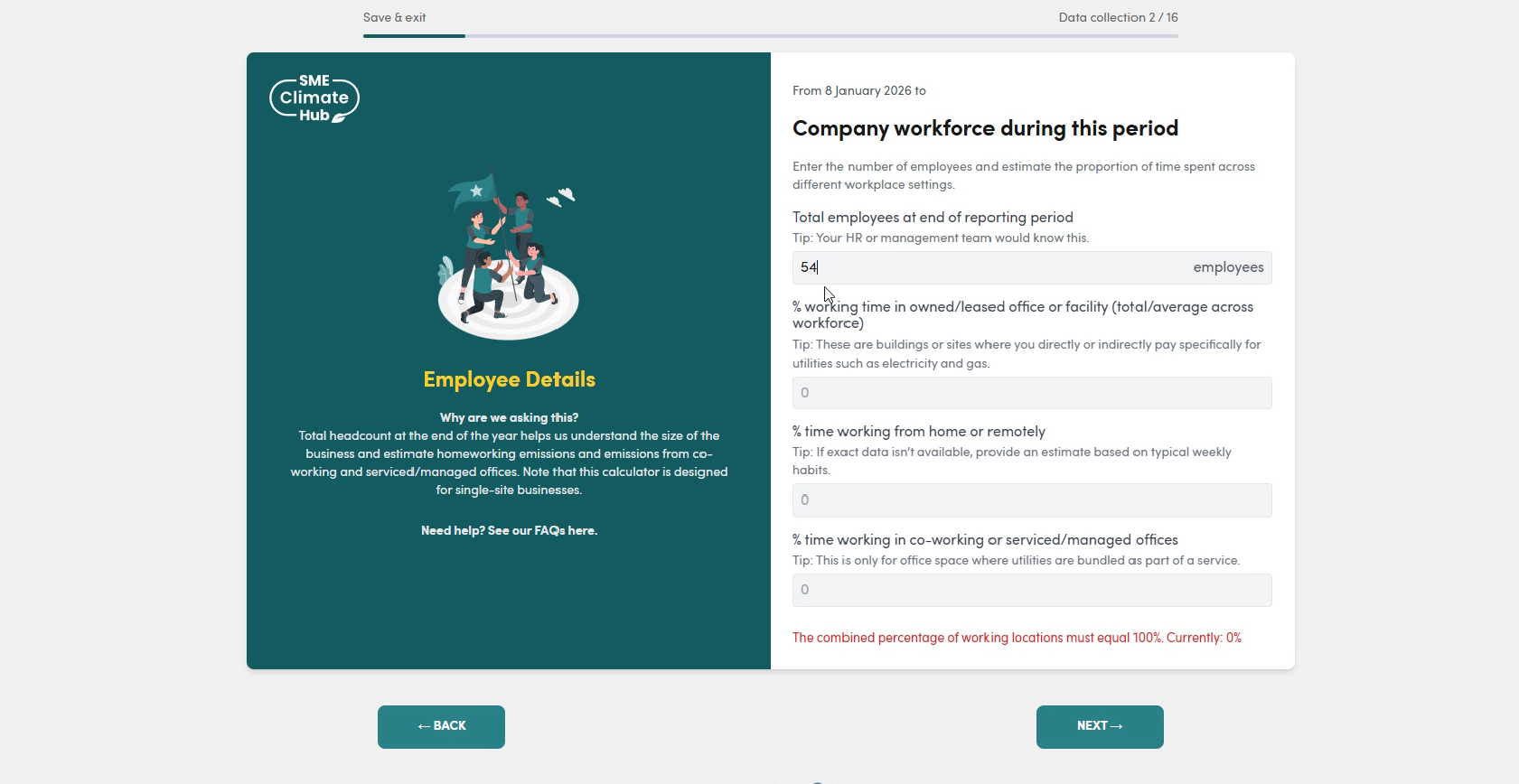
What it is – Automated sustainability reporting for smaller companies: connect your accounting system and GoClimate estimates emissions from your accounts, invoices and receipts, flags your biggest-emitting suppliers, and tracks progress monthly. Sweden-based.
Key features
- All three scopes, plus – uniquely here – a social-and-governance report alongside the carbon one
- Combines spend data with activity data where available, using GoClimate’s own factors (national/international data plus 50M+ Swedish accounting entries), checked by a human expert team; GHG Protocol aligned
- Scope 2 reported both location- and market-based; industry comparison, science-based targets, month-by-month tracking
Pricing – A subscription charged by the number of accounting entries (“vouchers”) per year, in SEK, with no lock-in. Mini from 350 SEK/month (≈ €30); Pro roughly €115–€385/month; Enterprise by quote.
For an SME, consider – There’s no free tier – you set up by connecting your accounting system or booking a demo, then subscribe. The automated baseline is spend-based (refined with activity where you have it) and its factors are tuned for Sweden; group reporting sits in the Enterprise tier.
Best for – Smaller firms that want the least typing, a measure-reduce-track loop, and carbon plus social and governance in one report.
7. Sage Earth
What it is – Carbon measurement built into Sage Accounting – “measure carbon alongside your finances in one place.” Originally Spherics, acquired by Sage; available to UK Sage customers.
Key features
- All three scopes, working mainly from your transactions (spend-based, quicker but rougher), with a more accurate activity-based method available; UK factors
- AI sorts each transaction into carbon categories automatically – you review and confirm, and it learns over time; dashboards highlight your biggest sources
- Accountant channel: via Sage for Accountants, a firm can run carbon for many small-business clients in one place
How you start – No standalone free trial: Sage Earth is a free add-on activated inside Sage Accounting. Non-Sage businesses take a 30-day Sage Accounting trial, then switch it on.
Pricing – The carbon feature costs nothing extra, but only as an add-on to a paid Sage Accounting subscription (£18–£59/month before VAT).
For an SME, consider – It’s UK-only and locked to Sage; the baseline is spend-based, the free view is a dashboard rather than a formal downloadable compliance report, and there’s no Greek local-law report.
Best for – UK businesses already on Sage Accounting, and accounting firms running carbon for many clients from one place.
8. Seedling
What it is – A UK carbon-accounting platform pairing self-serve software with a dedicated carbon expert on paid tiers, aimed at SMEs up to ~2,000 staff.
Key features
- Activity-based Scope 1–3 measurement (GHG Protocol), a granular emissions dashboard, science-based targets, reduction modelling and an offset marketplace
- Paid tiers add expert data review, GHG/PPN/B-Corp/SECR reports, CSV/PDF export, certification and a dedicated expert
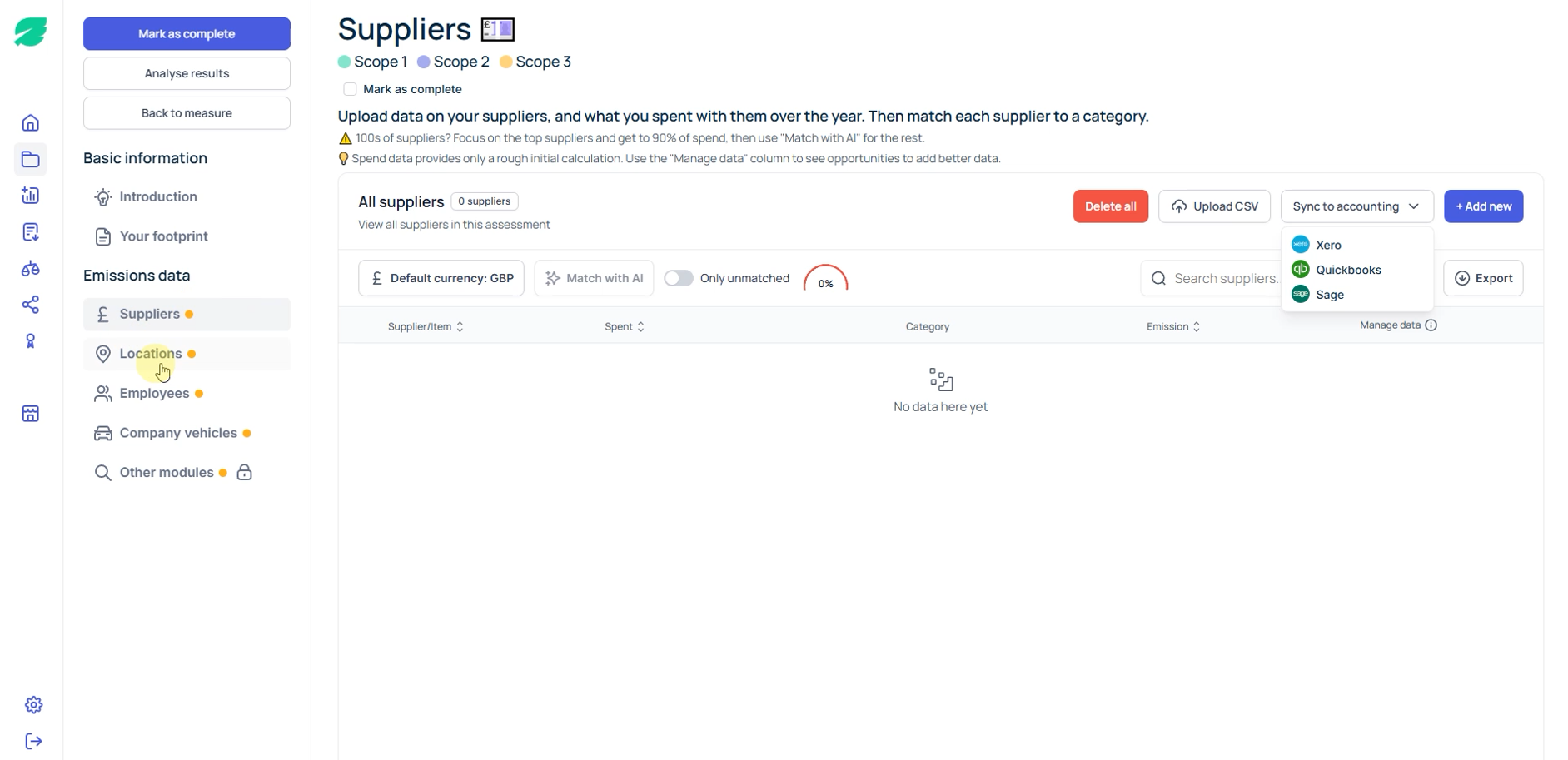
How you start – You can sign up to the free “Starter” tier without a demo, but it’s a hotspot estimate only – basic (spend-based) data, one site, and no report or export. The accurate footprint, reports and export sit in the paid Core/Advanced tiers, which are quoted after a demo (no public price).
Pricing – Starter free; Core and Advanced by quote (demo-led).
For an SME, consider – The free tier won’t give you a downloadable report – it’s a spend-based teaser – and the report-producing tiers have no published price, so you can’t compare cost up front. UK-focused.
Best for – SMEs that want a guided platform with hands-on expert support and don’t mind a demo-led, quote-based purchase.
How to choose Carbon Calculator tools
Four questions filter the list quickly:
- Can you start today, without a sales call? Several “self-serve” Carbon Calculator tools actually gate access behind registration, a demo or an existing subscription. If a bank or client is waiting, a tool you can sign up for and use now – Yodiwo, Persefoni Pro, SME Climate Hub, Sustrax Lite – is the difference between answering this week and next quarter.
- Do you want to pay once, subscribe, or stay free? A pay-per-report model fits what is, for most SMEs, an annual exercise; subscriptions suit continuous tracking; free tools (SME Climate Hub, Climate Compass) suit a first estimate. Watch for tools whose report sits behind a quote you can’t see up front.
- How accurate does your number need to be? A bank, auditor or CSRD-aligned report rewards an activity-based method with named factors, so your footprint falls as you cut emissions. A spend-based estimate is quicker and fine for hotspots, but can’t tell two suppliers apart.
- Who needs the output, and to which standard? “Compliant” should always name a standard. Questionnaires (CDP, EcoVadis) and CSRD alignment reward a report to the GHG Protocol and CSRD/ESRS E1; some tools here produce a dashboard or estimate rather than a formal report.
For an SME that needs an accurate footprint and a report to a recognised standard quickly, wants to keep ownership in-house, and would rather pay once than carry a subscription, a self-serve tool you can start for free – activity-based, with named factors, and a report aligned to the GHG Protocol and CSRD/ESRS E1 – is the most efficient fit.