July 2026 — a comparison of the tools companies use to collect and score their suppliers’ ESG data, for both small businesses and large enterprises.
Companies are increasingly asked to show what is happening in their supply chain — by customers, banks and the sustainability reports they file. A supplier sustainability assessment means sending your suppliers a questionnaire about their environmental, social and governance (ESG) practices, scoring the answers, and flagging the risky ones. This guide compares the tools that make that easy. Which one fits depends mostly on the size of your supply chain: a small business assessing a few dozen suppliers needs something quick and simple, while a large enterprise managing thousands needs deeper workflows.
Why assess your suppliers
Most of a company’s environmental and social impact — and much of its risk — sits in its suppliers, not its own operations. A supplier with a labour problem or no plan to cut emissions becomes your problem too. Three forces are pushing companies to assess suppliers now:
- Big buyers increasingly ask suppliers to prove their ESG performance before awarding contracts — so being able to answer quickly wins work.
- Lenders now factor supply-chain risk into credit decisions.
- The EU’s CSRD and the SME-sized VSME standard ask companies to report on their supply chain, and due-diligence laws (CSDDD, Germany’s LkSG, the deforestation rule EUDR) make supplier data a legal duty for larger firms — which then flows down to their suppliers.
Supplier assessment tools at a glance
| Tool | Best-fit size | How you start | Free for suppliers | Scoring | Feeds your own report | Pricing |
| Yodiwo | SME + enterprise | Ask for a demo (self-serve planned) | ✓ no account | ✓ weighted + AI text | ✓ Scope 3 / VSME same platform | Not yet public |
| Worldfavor | SME + enterprise | Demo (buyer); free signup (supplier) | ✓ free portal | ✓ automated | ○ data export | ~€5k/yr entry (reported) |
| Axiom | SME + mid | Sales-led | ? | ○ reports | ○ own carbon tool | Not public |
| IntegrityNext | Enterprise | Demo / quote | ? | ✓ + risk DBs | ○ CSRD module | ~€9.8k/yr Basic (reported) |
| Position Green (+Factlines) | Mid – large | Demo / advisory | ? | ✓ automated | ○ own suite | Not public |
| Cority | Large enterprise | Demo / implementation | ○ via licence | ✓ + Scope 3 engine | ○ own suite | Not public |
| Vizibl | Large enterprise | Demo / implementation | ○ via licence | ✓ two-level + programme | — uses bought-in data | Not public |
Legend: ✓ = yes / included · ○ = partial, indirect, or only on a paid/contracted tier · — = no / not the model · ? = not publicly confirmed. “Reported” pricing is from third-party software directories, not official vendor price lists. Worldfavor’s free signup is for suppliers sharing data; the buyer tool needs a sales conversation.
Quick picks
- Best for both small and large — Yodiwo — the same tool works for a small supplier base and a large, complex chain, growing with you. Learn more and ask for a demo at yodiwo.com or info@yodiwo.com.
- One suite for a smaller UK business — Axiom — supplier data, carbon and social value in one modular system; sales-led.
- Seriously Large EU supply chains — IntegrityNext — built for EU rules, with a huge pre-checked supplier network and always-on risk monitoring; enterprise, demo-led.
- Managing suppliers over time strategically — Vizibl — the strongest programme and group-scoring view; Position Green for software plus advisors.
The best supplier sustainability assessment tools in 2026
1. Yodiwo Supplier Sustainability Assessment
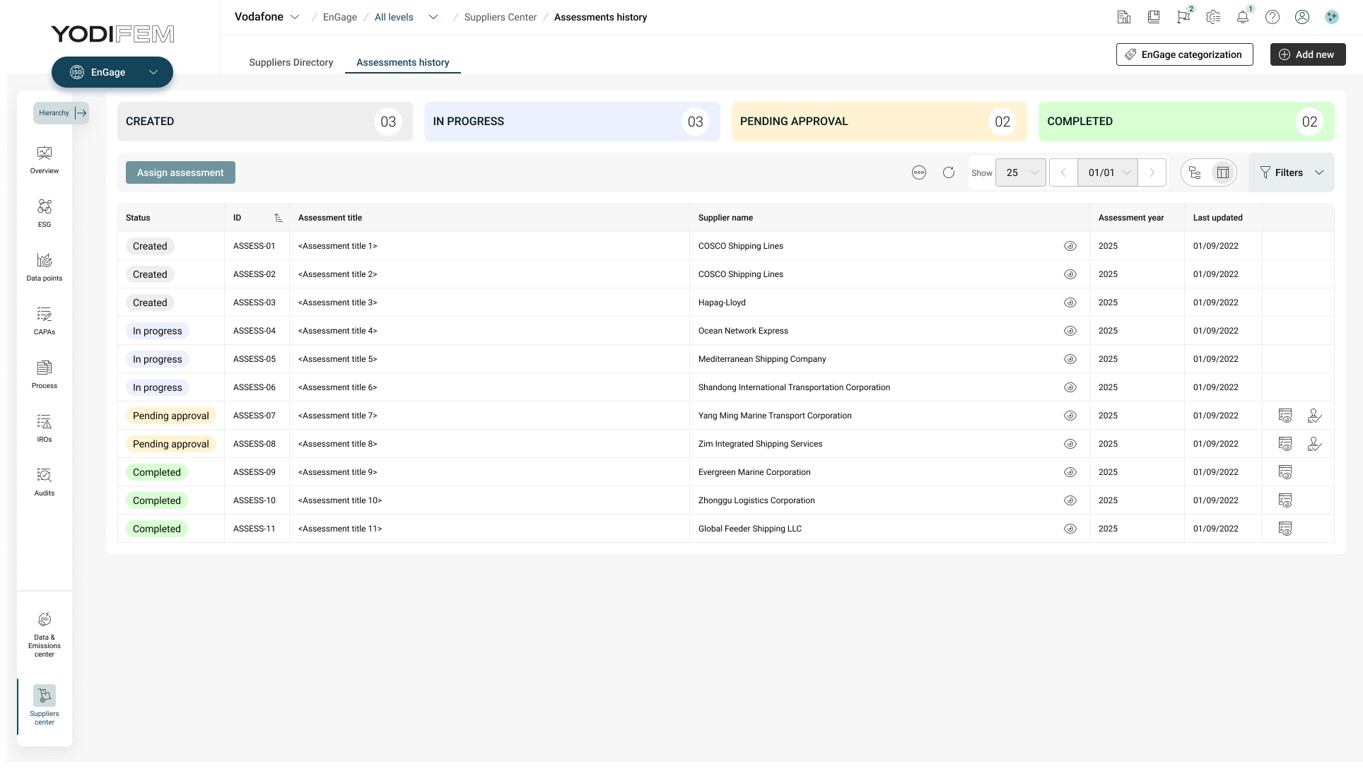
What it is — Yodiwo is a European sustainability-tech company with a suite of ESG tools — a self-serve Marketplace (carbon, VSME reporting, supplier assessment) for smaller companies, and the EnGage platform for larger, more complex ones. Its Supplier Sustainability Assessment lets you send suppliers a guided ESG questionnaire and get an automatic score with clear risk flags, instead of chasing spreadsheets. Because it runs in both the Marketplace and EnGage, it is the one tool here that suits a small supplier base and a large, complex chain alike.
Key features
- Ready-made ESG questionnaires (built for CSRD and Scope 3) that you can fully customise with your own questions
- Suppliers reply free, in English or Greek, in under 30 minutes — no account needed; reminders are automatic and progress is tracked
- Automatic scoring you can weight by topic, with clear risk flags and a dashboard that surfaces your riskiest suppliers; suppliers see their own score and how to improve
- Results can flow straight into your own carbon and CSRD/VSME reports — real supplier data instead of estimates — with one supplier list shared across Yodiwo’s tools
- For bigger needs, the EnGage tier adds supplier audits with a tamper-proof record, corrective-action tracking, and bulk requests by business unit or country
What sets it apart — It grows with you. The same questionnaires, scoring and supplier portal work whether you have 30 suppliers or thousands — you start in the self-serve Marketplace and move up to EnGage without switching tools or re-entering data. It is also the only tool here that can feed supplier answers straight into your own carbon management and CSRD/VSME, GHG etc. reports, rather than leaving you to copy data into a separate system.
Pricing — Not yet public; arranged directly with Yodiwo (self-serve pricing for the Marketplace tool is planned).
For a company, consider — The heaviest features — mapping a deep, multi-tier supply chain, connecting to procurement systems, and rolled-up scores across supplier groups — sit in the EnGage tier, so a very large or complex chain is served there rather than by the entry Marketplace tool.
Best for — Companies that want quick, clear supplier scoring with an easy experience for suppliers — from a small business assessing its main suppliers, to a large one needing audits and bulk requests — and especially those who also report their own carbon or CSRD/VSME with Yodiwo. Also handy for consultants running assessments for several clients
You can learn more here at DIY Sustainability Marketplace and book your demo.
2. Axiom Sustainability
What it is — A UK platform that bundles carbon accounting, ESG reporting, social value and supply chain in one modular system — buy one module or the lot. It serves “a small business or a global enterprise”, with UK small-business case studies, so it is one of the more small-business-friendly options here.
Key features
- Collects supplier ESG data and tracks their performance and compliance
- Supply-chain mapping that shows your chain for risk and sustainability tracking
- Procurement tooling that builds ESG criteria into your RFPs, comparing suppliers on sustainability as well as price
What sets it apart — One connected suite for a smaller buyer — carbon, ESG, social value and supplier data together, with hands-on UK support — handy if you would rather buy one system than stitch together separate tools.
Pricing — Not public; sales-led — “get in contact with our team”. No published self-serve start.
For a company, consider — The supplier module is one part of a broad sustainability suite rather than a purpose-built assessment workflow — supplier-visible scoring and a direct feed into your own CSRD/VSME report are less central here — and its supply-chain mapping and social-value features are built around UK frameworks, so EU fit is worth checking.
Best for — Companies that want supplier data alongside carbon accounting, ESG reporting and social value in one modular system — with supply-chain mapping and RFP/RFI/RFQ procurement tooling — and value hands-on UK-based support.
3. IntegrityNext
What it is — A Munich-based, AI-powered platform built around EU supply-chain rules (CSRD, CSDDD, CBAM, EUDR). With 600+ customers worldwide, it is one of the strongest enterprise tools for assessing suppliers at scale.
Key features
- Multilingual assessments aligned to regulations and standards (SBTi, GRI, CSRD, CSDDD), drawing on 30+ external risk databases
- A network of 2M+ pre-verified suppliers, so many assessments arrive part-filled; AI pre-fills, interprets and validates responses
- Continuous AI monitoring of millions of news sources for supplier controversies, with alerts — assessment plus always-on surveillance; corrective actions tracked to closure
- Pre-built connectors for SAP Ariba, Coupa, Ivalua and Celonis, embedding ESG scores into procurement workflows
What sets it apart — Built for EU rules, and always-on: instead of a once-a-year check, it scans the news for supplier problems and alerts you between assessments. A 2026 partnership now packages it for mid-sized companies too.
Pricing — Demo- and quote-led; a third-party directory lists a Basic tier at about €9,800/year (a directory figure, not an official price). The site’s “Test for Free” leads to a request/demo rather than an instant signup.
For a company, consider — Its strengths — the 2M+ supplier network, news-monitoring and Ariba/Coupa connectors — are built for large, procurement-led operations; Independent reviews rate its reporting and analytics as less mature than its core assessment and monitoring features, and the assessment scores export to a separate tool rather than becoming your own CSRD/VSME report.
Best for — Larger organisations with EU due-diligence obligations that want the pre-verified supplier network, continuous news-based risk monitoring and procurement-system integration across a broad supplier base.
4. Position Green (with Factlines)
What it is — A Nordic ESG software-and-advisory group serving mid-sized and larger European companies, with CSRD reporting, carbon accounting and supplier sustainability in one platform. In December 2025 it bought Factlines, a Norwegian supply-chain due-diligence tool, strengthening its supplier side.
Key features
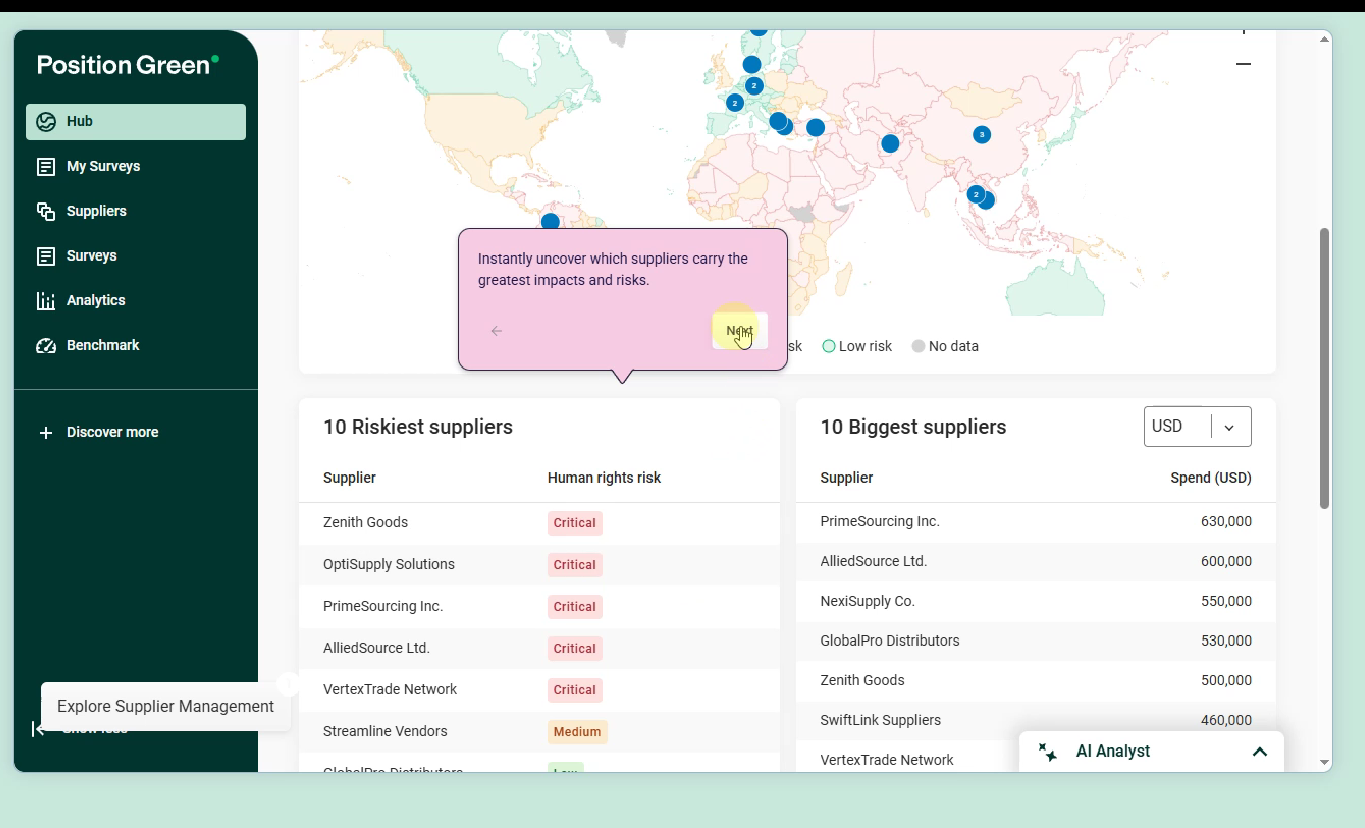
- A supplier-management module that maps risk to prioritise who to engage first; ready-made or custom survey templates; automated follow-ups and a logged supplier chat that keeps an audit trail
- Automated scoring that rates each supplier on a validated scale (e.g. an overall “Adequate Risk Management” rating out of 7) with a per-category breakdown — due diligence, work-related incidents, wages — and an in-app AI Analyst; survey dashboards track completion, in-progress, overdue and answered
- AI embedded across the suite, including anomaly detection and benchmarking; ERP integration combining internal and external data
- In-house advisors who support assessments, scoring and compliance hands-on; Factlines adds due-diligence mapping and management across suppliers
What sets it apart — Software plus people: you get a broad ESG platform and a team of consultants behind it — good if you want guidance as much as a tool — and its supplier depth is growing through acquisition.
Pricing — Not public; demo- and quote-led, with a buyer profile of mid-to-large organisations.
For a company, consider — Its scoring gives a category rating out of 7 rather than a financial or Scope 3 figure, and that result sits in the Position Green platform rather than feeding your own carbon or CSRD report \u2014 so it tells you a supplier\u2019s risk band without doing your emissions or disclosure work for you.
Best for — Mid-to-large European organisations that want the supplier module’s risk-based prioritisation, logged supplier chat and anomaly-detection AI alongside a full ESG reporting suite and hands-on advisors.
5. Worldfavor
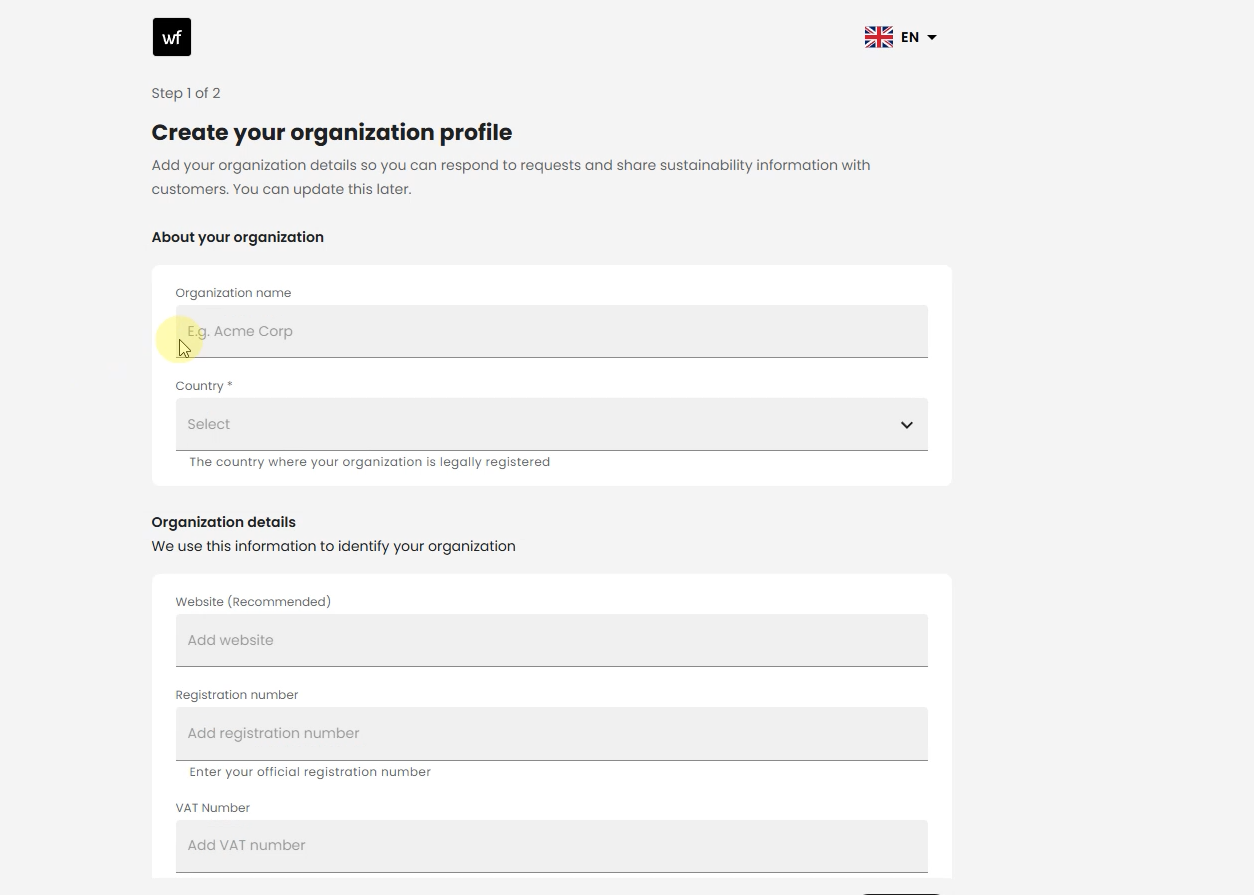
What it is — A Stockholm-based platform built as a shared supplier network. You import your suppliers, get quick AI-generated ESG scores and risk profiles, then dig deeper with questionnaires. It serves everyone “from Fortune 500 companies to SMEs” — the most small-business-friendly of the dedicated platforms.
Key features
- Automatic ESG scoring and risk profiles per supplier, plus corrective-action tracking
- A free supplier portal (suppliers share data at no cost) in 100+ languages, which helps response rates
- Visibility beyond your direct suppliers, live dashboards, and compliance workflows for CSRD, CSDDD, EUDR and SFDR
What sets it apart — The shared network. Many suppliers already have a profile, so questionnaires start part-filled and suppliers can reuse answers with other customers — less “blank form” friction, better response rates.
Pricing — Split by side. Suppliers get a genuine free, self-serve signup (with a short approval step). The buyer platform is demo-led and quote-priced; a third-party directory reports buyer tiers from about €5,000/year for up to 100 suppliers — a reference point, not an official price.
For a company, consider —Supplier scores and risk profiles live inside Worldfavor’s sourcing platform and come out as exported data rather than feeding your own Scope 3 or CSRD/VSME report, so you move the results into your own reporting yourself.
Best for — Companies that want the network pre-fill and free supplier portal to lift response rates, multi-tier visibility and automated corrective-action flows, and are comfortable running the buyer platform after a demo.
6. Cority
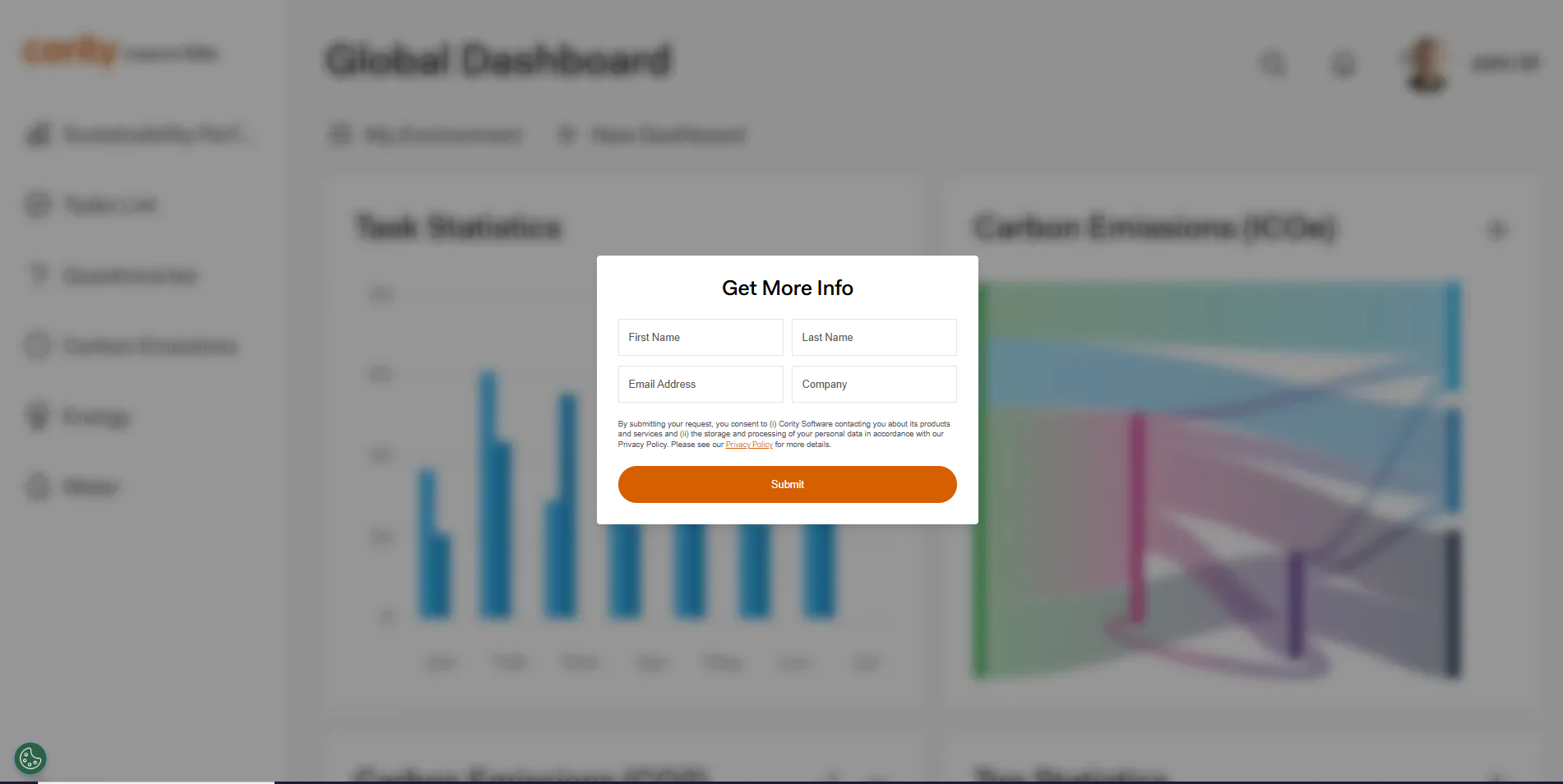
What it is — A 40-year-old enterprise health, safety and sustainability platform used by 1,500 large organisations, including some of the world’s biggest manufacturers. Its supply-chain module collects supplier data at scale.
Key features
- Configurable questionnaires aligned to frameworks and standards; supplier scorecards and compliance dashboards
- A built-in library of over a million emission factors, turning supplier data into Scope 3 calculations — the deepest carbon capability in this list
- Two-way supplier communication with corrective plans inside supplier programmes
What sets it apart — Serious Scope 3 depth inside a mature, wide safety-and-sustainability system — built for very large, complex organisations that want supplier assessment as one part of a bigger estate.
Pricing — Not public; sold via demo as enterprise contracts (typically multi-year) with an implementation project.
For a company, consider — The million-plus emission-factor library and EHS-suite breadth are built for large, operationally complex estates; a company that only needs to score a supplier base will not use most of the platform, and onboarding is an enterprise implementation with configuration and rollout rather than a quick self-serve start.
Best for — Large enterprises that want supplier scorecards and corrective plans inside a mature EHS suite, with the deepest Scope 3 emission-factor library in this list turning supplier data into carbon numbers.
7. Vizibl
What it is — A UK enterprise platform where a big company’s procurement team manages its most important supplier relationships — joint plans, projects, improvement — with a sustainability layer on top. It is the clearest example of managing suppliers as ongoing programmes rather than one-off scores.
Key features
- Two-level scoring: each supplier gets a score, and a group of suppliers rolls up into one programme score (e.g. “Supplier Net Zero 2030”)
- Named programmes with suppliers assigned, and year-by-year improvement targets at group or individual level
- Recognised frameworks (CDP, SBTi) attached to programmes, plus collaboration projects to track progress
What sets it apart — The best programme and portfolio view here — rolled-up scores, improvement roadmaps and collaboration — made for managing strategic suppliers over years, not scoring them once.
Pricing — Not public; demo-led enterprise sales. It draws on partners (CDP, EcoVadis) for underlying supplier data rather than running all assessments itself.
For a company, consider — Its programme and portfolio-scoring features assume a large procurement team managing strategic suppliers, and the scores draw on bought-in data (CDP, EcoVadis) rather than questionnaires it runs itself — so it complements a rating source rather than being your own assessment-and-reporting tool.
Best for — Large enterprises that want two-level supplier scoring, named programmes and target roadmaps to manage strategic-supplier improvement over multiple years, not one-off assessment.
How to choose
Four quick questions narrow it down.
- How big is your supply chain? — A few dozen to a couple of hundred suppliers is a small-business job (Yodiwo, Worldfavor, Axiom). Thousands across many countries is an enterprise job (IntegrityNext, Position Green, Cority, Vizibl, or Yodiwo’s EnGage tier). Picking a tool built for the wrong size is the most common and costliest mistake.
- How easy is it for suppliers to reply? — Your response rate depends on it. Look for ready-made questionnaires, plain scoring and a supplier experience that does not force every supplier to create an account or pay — Yodiwo and Worldfavor both let suppliers reply free.
- Can you start quickly? — Some tools show an interactive tour on sample data (Position Green is a good example), but starting with your own suppliers at a known price usually still means a demo and a quote. If speed matters, look for a clear path to a published price and a fast start.
- Where does the data end up? — A supplier score is only useful if it lands where you need it. Most tools leave you to copy data into a separate carbon or CSRD tool; if you also report your own emissions or CSRD/VSME, a tool like Yodiwo that feeds supplier answers straight into those reports saves real work.